The Waiting Room Daydream
Let me set the scene for you properly.
It’s a Thursday night, or possibly a Friday — I’ve genuinely forgotten, which tells you everything about how the week went. I’m sitting in the car, engine off, waiting to pick Abi up from her works night out. The radio’s down to nothing. The phone’s on about four percent because I’ve been using it as a torch for something. And there’s that particular quiet you only get in a car park when everyone else has gone inside and the only sound is the little ticking as the engine cools down.
And my brain, which has been doing exactly what it’s told for five days straight, suddenly stops doing what it’s told.
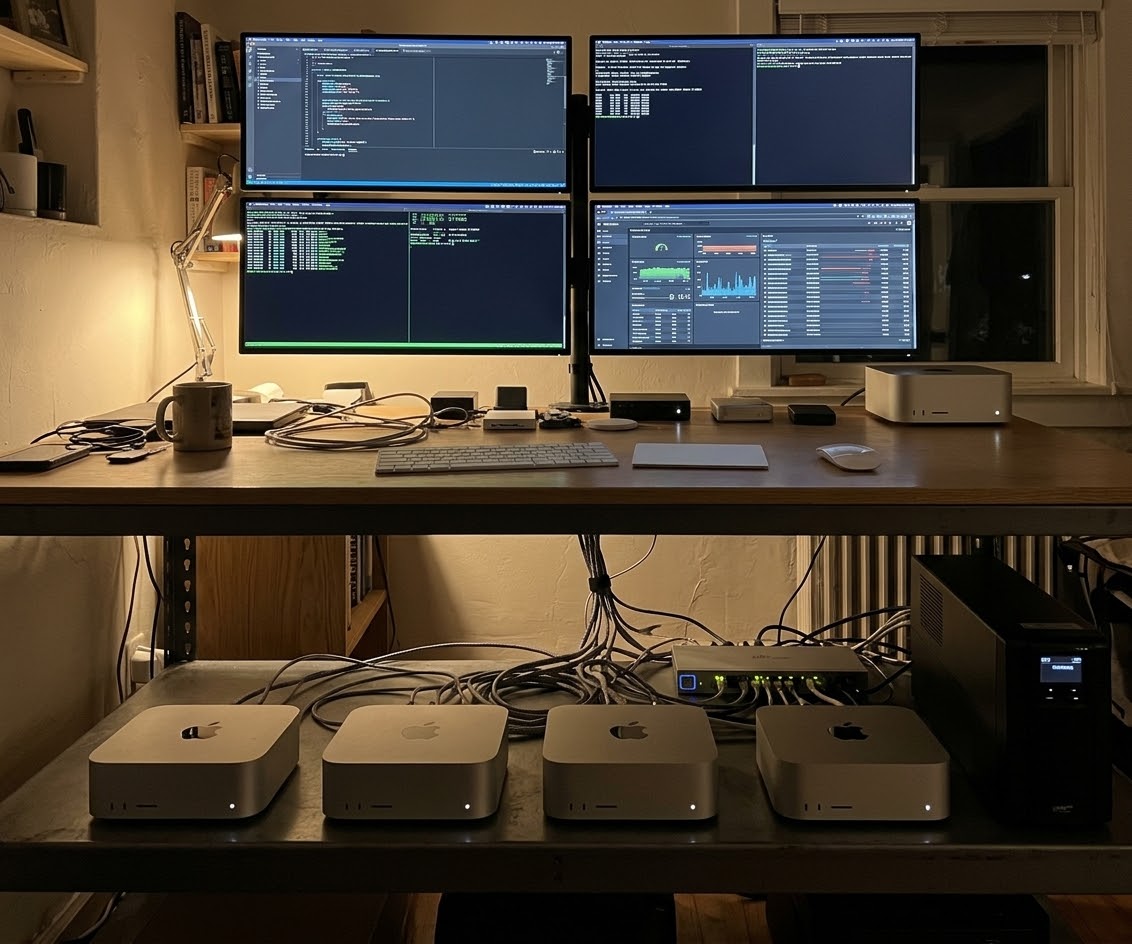
Here’s the thought that turned up, fully formed, no warnings, no negotiating: it would be absolutely brilliant if somebody bought me five top-of-the-line Mac Studios. Four of them wired up purely for inference, humming away in the corner doing the heavy lifting. One on the desk for me to actually use. All the cables. All the networking. One of those shelves that’s rated for more weight than you think you’ll need, because you always need more weight than you think you’ll need. And then, on top of that, employed me to mess about with artificial intelligence for roughly three thousand five hundred pounds a month, after tax, landing in the bank on payday.
Not a bonus. Not a share option. Not a “great exposure opportunity.” A wage. For playing.
I want to be clear about what sort of thought this was, because the distinction matters. It wasn’t “wouldn’t it be nice to win the lottery.” It was far more specific than that, and that’s what made it funny. It had a headcount of one. It had a hardware topology. It had a number attached. It was a fully costed fantasy for a job that does not exist, assembled in about ninety seconds in a stationary car, and I could not have told you where any of it came from.
The really strange bit is how constructively my brain was behaving. It wasn’t sitting there going “oh, I’m tired.” It had got past the self-pity and gone straight to procurement.
I think waiting rooms do this to you. That’s why I’m starting here. When you’re waiting — for a person, for a call, for a kettle, for the next stage of your life — your brain has got nothing to push against, so it starts building things out of the raw material of whatever you’ve been thinking about lately. Mine has been thinking about artificial intelligence, and about being tired, and about the small apps I knock together after the kids are in bed. Put those three things in a car park and shake them up, and this is what falls out.
So I sat there and I designed the job. And then I started wondering whether it was only a daydream, or whether there’s an honest answer to the question underneath it.
Because the question isn’t really about the Mac Studios. It’s this: are there actually people out there who would like me to show up in the morning with a random idea not tied to anything, and just go and play?
That’s the question I want to spend the next hour on. Not the answer — I’ve got a feeling the answer is “no, but.” I want to spend the hour on the question, because working out why it’s “no, but” turns out to be more interesting than the dream itself.
Right. Let’s go and have a look at it.
YEARS ON THE FRONT LINE
Before we get to the fun bit with the cables, I should tell you where the daydream came from, because it didn’t come from nowhere.
I’ve been working in customer-facing roles, in one form or another, since I was sixteen. And I want to keep this broad, for reasons I’m sure you can imagine. I’m not going to name anybody I’ve worked for. I’m not going to describe a particular customer, or a particular call, or the specific thing somebody said that made me want to put the headset down and walk into the sea. That’s not the post, and besides, the job comes with confidentiality, and confidentiality doesn’t take a holiday because I’ve decided to write an essay about my feelings.
So here’s the shape of it, which is all you need.
Nowadays I work from home. I take calls, five days a week, from nine in the morning until half past five. Then I log off, stand up, and walk downstairs, and that’s the boundary. There’s no commute. There’s no door to close behind me. It’s a flight of stairs. But it works, in the sense that the second my foot hits the bottom step, I’m not the person on the headset any more. I’m just a dad, and there’s tea to make, or an argument about a screen to settle, or a small human who has built something out of cardboard and needs it admired immediately.
Before this it was live events, on the technical side. And that sounds like a complete change of pace, and in some ways it was. But here’s the thing I didn’t understand until later: even when I was doing the technical side of events, there was always somebody customer-facing involved. It’s part of the gig. You can be the person who knows the entire signal chain back to front and it still doesn’t matter, because at some point somebody is going to tap you on the shoulder and ask whether the screen is meant to do that, and the answer is going to have to come out of your mouth in a tone of voice that suggests you’re not currently having a small breakdown about the screen.
I’ve spent most of my working life being pleasant for a living. That’s the sentence I’m circling. Not hard work — lots of people work hard. Being pleasant. It’s a specific kind of tiredness, the kind where nothing physically happened to you but you feel like you’ve been carrying a heavy sofa up a hill since breakfast. You have been friendly at people who are not being friendly back. You have said “I understand completely” to things you absolutely do not understand. You have apologised on behalf of a situation you did not create, for a problem you cannot fix, to somebody who has every right to be annoyed and no way of knowing that the person they’re shouting at has also had a long week.
And then you log off, and you walk downstairs, and you do it again tomorrow.
I want to be careful here, because I’m not asking anybody to feel sorry for me. I’ve got a job. It pays. Lots of people have it far worse, and a fair few of them are on the other end of the calls I take. What I’m describing isn’t a crisis. It’s a slow leak. Burnout isn’t a dramatic event when it happens to you; it’s a series of Tuesdays. You don’t notice the tyre going down until you’re somehow riding the rim.
Here’s the part that matters for the rest of this post, though. That tiredness isn’t just something that happens to me and then goes away when I log off. It’s where the ideas come from.
I know how that sounds. It sounds like I’m about to tell you that my difficult job is secretly a gift, and I’m not. If there’s a gift in it, I’ll take it without being grateful for the circumstances. But it’s true that nearly every tool I’ve built started as a small irritation at work. Something taking four websites instead of one. Something that needed a number worked out for the fifth time this week. The ideas don’t arrive when I’m relaxed and sitting on a beach; they arrive in the middle of the work — three tabs deep in somebody else’s website, trying to answer a question that ought not to need four of them. And then I leave them there. When I’m working, I’m working. Nothing gets built until I’ve logged off.
So the daydream in the car park wasn’t escapism in the usual sense. It wasn’t me trying to get away from the work. It was my brain, having finally stopped taking calls, using the first quiet moment it had found all week to ask what the other version of my life would look like.
That’s all this section is. Not a complaint. Just the reason the daydream has any weight to it.
CORPORATE BUZZWORDS VERSUS ACTUAL TUESDAY MORNINGS
There’s a language we use about work that has almost nothing to do with work.
You know the one. Synergy. Transformation. Agile enablement. Thought leadership. Wear many hats. Circle back. Move the needle. A fast-paced, dynamic environment where no two days are the same — which, if you’re in customer service, is absolutely true and not in the way the person writing the advert meant it.
I read a lot of these adverts, or I used to, back when I was looking at other jobs. And I’d read them and think: this is a description of a job that somebody invented in a meeting about a job. It isn’t a description of what happens on a Tuesday.
Here’s what happens on an actual Tuesday. You go upstairs into the spare room that’s the office now, shut the door, and work. And when I say work, I mean it: when I’m on, I’m on. There’s coffee, there are messages, there’s a call about something that could have been an email, and for the whole shift the side projects get precisely none of my attention, because I can’t do both at once and I’m not going to sit here pretending I can. That’s the job. That’s what I’m paid to do.
The ideas don’t respect the boundary, though. You can’t tell the bit of your brain that notices things to clock off at at nine in the morning and come back at five thirty. A thought will turn up in the middle of a call — the power cut map started exactly that way — and all I can do is hold onto it and get back to the person I’m talking to. Then I log off, walk downstairs to the family, and later, when the kids are in bed, I open the laptop and follow the thought properly. Something breaks locally. I fix it. I break it again in a slightly different way. I move on to something weirder. That’s the whole evening. That’s the thing nobody writes a job advert about.
And I don’t want to be too hard on the buzzwords. I’m not having a go at anyone who likes a stand-up, or anyone who genuinely thinks “transformation” is a useful word. If it works for you, brilliant. My objection is narrower: the language makes the work sound smaller and shinier than it is. It takes something messy and human — a person, a phone, a problem, a solution that’s about seventy percent right — and wraps it in words that sound like they were generated by a printer that’s run out of ink.
Here’s a better description of my ideal Tuesday, in the language I’d actually use: I turn up, I follow whatever the interesting thought is, I break a few things, I fix most of them, and by four o’clock there’s a working prototype of something that did not exist that morning. Nobody asks me what the key performance indicator was for the thing I made at eleven, because the thing I made at eleven wasn’t on the list. That’s the whole appeal.
Right. You can probably see where this is going. The fake corporate version of my dream job would be unbearable. “Seeking a visionary local-first artificial intelligence pioneer to drive synergy across the unstructured innovation space.” I’d resign before the onboarding.
The real version is just… Tuesday. With better hardware.
THE BLANK-CANVAS TRAP
Here’s a thing I’ve noticed, and it’s the first genuine problem with the daydream.
Five Mac Studios and no tickets. No boss. No queue. No deadline. No status update on Friday afternoon. On paper, that’s heaven. It’s the thing you think you want when you’re halfway through a particularly long call and somebody’s asking you to hold.
But total freedom has its own friction, and I don’t think people talk about it enough.
When there’s nothing telling you what to do next, the blank screen gets very loud. You sit down with all that compute and all that possibility and… nothing. You open one thing, close it, open another. You spend three hours perfecting a tiny local workflow for a problem nobody has. You build a scripts folder that would make a grown engineer weep, and at the end of it you sit back and ask yourself the question you can’t quite put into words: was that bliss, or was that madness?
Honestly? Usually both.
I’ve had a version of this with the blog. I’ll finish a big series — the Bridlington Mesh, say, seven posts and one very large spreadsheet — and I’ll have two days where I can’t start anything. The freedom is the problem. There’s no next ticket. The last thing finished, and nothing is currently on fire, and my brain, which is perfectly happy to be told what to do, just sits there waiting for an instruction that never comes.
What gets me moving again is almost always a constraint. Not a grand plan. A small, stupid constraint. Somebody says something on a call and I think “that should not need four websites” — and then I put it to one side and get on with the call. Or one of the kids wants a house points thing like they have at school and I think “right, I’ll build a house points thing.” That’s it. That’s the engine. An itch, and a reasonably clear idea of what scratching it would feel like.
The blank canvas is a trap because it looks like the maximum amount of freedom, when actually it’s the maximum amount of work. You have to supply the idea as well as everything else. Whereas a constraint — a tiny, annoying, specific constraint — does half the job for you. It tells you where to start.
So even in the fantasy, even with the four inference boxes purring away in the corner, I reckon I’d still need something small and stupid to begin with. The job wouldn’t be “go and play.” It would be “go and play, and here’s a pile of small irritations to aim at.” Which is basically my life now, except tired and on one machine.
But that’s a problem I’d happily have. Let me tell you what happens when the constraint turns up.
WHAT HAPPENS WHEN YOU JUST PLAY
I should say what I mean by play, because it’s an easy word to wave around.
I don’t mean messing about in the sense of wasting time. I mean working on something with no business case, no roadmap, no quarterly goal, and no intention of turning it into a product. You start with “I wonder if I could” and you finish — if you finish — with a thing that works. In between, you let the tools do as much of the heavy lifting as they’ll do, and you steer.
That’s the bit that’s changed everything for me. I’m not sitting down and writing a points tracker line by line any more. I’m describing what I want, looking at what comes back, saying “no, not that, this,” and nudging it until it’s right. Half the time I don’t fully understand why the thing works. That’s okay. I know what it’s meant to do, I can see whether it does it, and I can tell when it’s talking nonsense. The rest of it — the plumbing, the boilerplate, the fifty lines of code that look like somebody sneezed into a text file — that’s the machine doing the lifting, not me.
I reckon that’s why I enjoy it so much. For most of my working life, the useful thing I’ve had to offer has been my ability to follow a process accurately while remaining pleasant. And here, suddenly, the useful thing is the idea. The weird, specific, unasked-for idea. Somebody still has to notice that the idea is worth having, and that somebody is me, but the cost of trying it has collapsed to almost nothing.
The purest example is the points tracker I built for the kids. It does exactly what it says. Each child collects points when they’ve been good and loses them when they haven’t, and when they get to a certain number, there’s a big treat in it — ice cream at Mr Moo’s, or picking what we do on our Sunday family day, although there’s a strict rule that if shops are involved, the choice has to be made before ten o’clock, so we have time to get to the shop before it closed (stupid Sunday trading hours!!!).
That’s the whole idea. That’s the specification, such as it was. And then I built the thing that does it.
It’s called Kajo. There’s a little web app, a version that runs on the telly, and — this is the bit that still makes me grin — you can talk to it. You can say something like “give Scarlett three points for tidying her room” to the smart speaker in the kitchen, and it goes on the board. Or you can take a point away, because the system does both. There’s a ledger, so it knows what happened today, this week, this month and all time, and there’s a reason attached to every entry. Somebody helped out. Somebody went to the doctors. Somebody had, in the words of the little voice model I ended up writing, “good behavior.”
It will never make a penny. Nobody outside my house has any use for it. It took rather longer than one evening, if I’m honest. When it first worked — when I said the words out loud and the number changed on the screen — I felt a genuinely stupid amount of pleasure. More pleasure, probably, than anything I’ve done at work this year.
And that’s the thing I’m trying to get at. The number going up didn’t matter. It’s a number. But it was my number, on a thing I’d decided to build, at a time nobody had told me to build it. That’s the whole feeling. That’s the drug.
I should be honest about the downside, though, because otherwise this turns into a brochure. Most of what I make in this mode is throwaway. It gets used twice and then it sits in a folder. I’ve got app ideas in various states of half-finished that will never see the light of day. Some of them were stillborn. Some of them were quite good and I got bored. If you’re the sort of person who needs everything you touch to become a business, this would be a terrible way to spend a day. You’d look at the pile of half-things and see waste.
I don’t see waste. I see a pile of half-things, and a few whole ones, and the whole ones are the ones I’m about to show you.
The other honest bit is the contrast with the call queue. At work, the measure is throughput. How many, how quick, how many today. It’s not a bad measure — it’s how you keep a queue moving — but it’s not a measure of anything I care about when I’m at home. At home, nothing is measuring me. There’s no tally. And somehow, with no tally, I finish more things than I do in a job that’s built entirely around tallies.
Which is either a profound insight about motivation or just what happens when you’re allowed to stop at five and go and do something else. Probably the second one. But I’ll take it.
THE DAYDREAMER’S TRACK RECORD
Right, receipts. But I want to do this without turning it into a CV, because the second you line these things up in a list they start looking like achievements, and achievements are the opposite of the point.
The points tracker I’ve just described. That’s the little one. It exists because two small people collect points, and because a trip for ice cream is a very powerful motivator in this house.
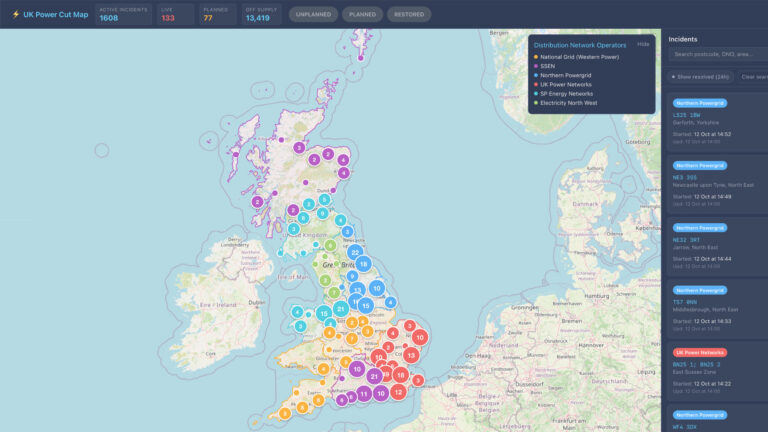
Then there’s the power cut map. That one started on a call. Someone had lost their electricity and wanted to know whether it was their fault or the grid’s, which sounds like a simple question until you find out that electricity distribution in this country is split between six separate companies, each with its own website, none of which publish their data anywhere the others do. So you’re three tabs deep on a call, saying “bear with me” in the voice of a man who is not entirely sure what he’s doing, and the thought that turns up is: this should not need four websites.
So I built one. It pulls live power cut data from all six operators onto a single map. It’s running; you can look at it. And I want to be careful here for exactly the same reason I was careful earlier: none of this is official, nobody at work knows about the post, nobody’s reviewed it, and nobody owes me a favour for having built it. It isn’t an employee benefit. It’s a thing I made because the friction was in front of me every day and eventually I got annoyed enough to remove it.
I’m not going to tell you about the call that inspired it. There are versions of that story that would make a much better paragraph, and I’m not allowed to write them, because they’d be somebody’s bad evening described on the internet. So you get the shape instead. Four websites, six companies, one map. That’s the whole story, and it’s honest.
Then there’s KPI Quest, which is a competition platform — key performance indicators, turned into something with scores and a bit of a game wrapped round it. I don’t think it needs a serious explanation. It’s a dashboard with a scoreboard, which is my favourite combination of things.
And then the long-form stuff, which is where the daydreaming becomes visible as a habit rather than a one-off.
The Carnaby Media Hub is a theoretical media campus on an industrial estate outside Bridlington. A theatre, film and television studios, a virtual production stage, radio studios, recording rooms, rehearsal spaces, workshops, research labs, and offices and classrooms above all of it, all sharing one network backbone. I found the site while doing my driving lessons, of all things. The instructor took me up to the estate to practise roundabouts and I ended up looking at a plot of land the size of nineteen thousand square metres and mentally filling it with a twenty-four-hour broadcast network. Nothing was ever built. It’s a blueprint in words, and there’s a complete blog series for it.
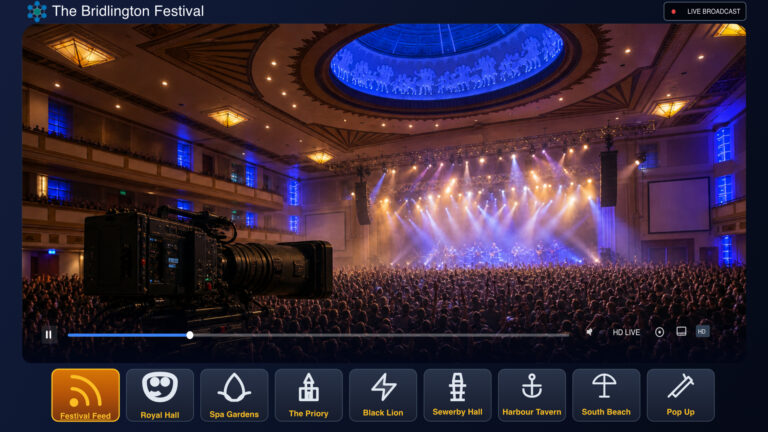
The Bridlington Mesh is a different animal. That one’s a town-wide broadcast blueprint, seven posts about a festival that does not exist, spread across venues in a town I happen to know, from a pub back room all the way up to a main-stage beast, feeding an outside broadcast truck and a Red Button-style experience where you can sit at home and flick between stages. There’s a spreadsheet underpinning the whole thing that got genuinely out of hand, and by the end the notional bill was around one point two million pounds.
Those posts are daydreams with a hard drive attached. Nobody asked for either of them. There was no brief. I just kept following the thought and it kept turning into chapters.
And the one-offs. A fully automated radio station with an artificial intelligence DJ. Auto-mixing dance tracks in the style of Pete Tong. Random deep dives into tech that I fancied understanding properly, which usually means I spend three days reading about it and then write six thousand words about it. None of it paid. Almost none of it was requested.
So when I say I already show up with random ideas not tied to anything, I mean it literally. I’ve been doing it for years. Every one of those things started as “I wonder if I could” and got built in the gaps — the evenings, the car park waits, the twenty minutes before the kids’ bedtime. The only difference between what I do now and the job in the daydream is that I do it tired, after hours, on one machine.
I want that difference to be smaller. That’s the whole post, really.
FOUR INFERENCE BOXES, ONE HUMAN DESK
Let’s get back to the hardware, because it’s the silliest part and I’ve been looking forward to it.
The fantasy has a very specific shape. Four top-of-the-line Mac Studios, all linked together over Thunderbolt, doing inference — that is, running the models, generating the output, chewing through the work — and a fifth machine on the desk for me, paired with four Studio Displays. I know that’s a lot of screens. I’ve got used to working across four and I can’t give them up now.
And there’s a reason it’s four. It isn’t a number I picked because it sounded good, although it does. From what I’ve read, Apple said a Mac Studio can talk to three other Mac Studios and that’s the limit, so four is the cap the hardware sets. I’ll happily be told I’ve misread it, but it’s a much nicer justification than “I thought four looked good on a shelf,” so I’m keeping it.
On the four boxes: models running locally. No application programming interface bills. No rate limits. No token anxiety. No waking up to find that a loop has been running since two in the morning and has quietly cost more than the electricity. Offline. Air-gapped. If the internet goes down, nothing changes, because nothing in the setup needs the internet. That’s the appeal, and it’s a genuine one — not the “offline” aesthetic, but the practical fact that a thing you can run yourself is a thing nobody can switch off, throttle, or price-change on a Tuesday.
Also, I’ll be honest, I like the physicality of it. Four boxes humming on a shelf, a switch with more ports than I need, a drawer full of cables that all actually do something, and a fan I can’t quite silence. Warm electronics smell. I like knowing where everything is. I like being able to point at a cable and say what it’s for. That’s probably the engineer side of me, the bit that came from live events, where the entire signal chain is something you can touch and trace with your finger.
The one on the desk is mine. I’m not leaving myself short of a top-of-the-line workstation, thank you very much. There’s modelling in Blender, there’s running a build of a Next J S project that I’ve somehow managed to break again, there’s video editing with more effects than the timeline has room for, and then there’s the one I’m most curious about: hooking this desk up to the monster on the other four machines and pairing it with the ArtCraft suite of apps to see what comes out. I don’t know what that produces. That’s rather the point.
But here’s the bit that matters, because it’s easy to get this backwards. The boxes don’t have the ideas. They don’t know which thought is worth an afternoon. They’ll happily generate six versions of a bad idea and a seventh version that’s actually quite good, but they’ve got no way of telling you which is which. That’s still my job. Taste. Judgement. Knowing when something works, knowing when it’s nearly working and I should keep going, and knowing when to stop, shut everything down, and walk downstairs.
So the split is: machines do the generating, I do the choosing. That’s not science fiction. That’s just an arrangement of a working day, and a fairly sensible one.
The honest caveat: I’ve never actually run four machines doing inference at once. I don’t know if that’s the right number, or if it’s overkill, or if I’d spend all my time administering the wretched things instead of building with them. There’s a version of this fantasy where I become a full-time systems administrator for a cluster of four, and the creative work never happens because I’m forever updating something. But that’s the thing about daydreams — the admin doesn’t get a vote. In the daydream, the shelf just works.
Nothing in the daydream ever just works. Which brings us neatly to the bill.
THE YEAR-ONE BILL
I like pricing things up. It’s a flaw. Give me a fantasy and I’ll immediately open a spreadsheet and ruin it with accurate numbers.
And by accurate numbers, I mean I actually did this. Properly. With a spreadsheet, and quantities, and a column at the end headed Total. This is the point in the post where the daydream stops being a daydream and becomes a shopping list, which is a much less fun thing to be holding at half past eleven at night.
Right. Here’s what the shelf costs.
Five Mac Studios. The top-of-the-line ones, with the M-five Ultra chip, five hundred and twelve gigabytes of memory and sixteen terabytes of storage each. Twenty-nine thousand seven hundred and seventy-nine pounds apiece. Five of them: one hundred and forty-eight thousand, eight hundred and ninety-five pounds.
I want you to sit with that number for a second. One hundred and forty-eight thousand pounds. Of computers. Not a building. Not a van. Computers.
Then the bits around them. Four Studio Displays, the nano-texture glass ones with the VESA mounts, at one thousand seven hundred and ninety-nine pounds each, which is another seven thousand one hundred and ninety-six. A Magic Keyboard with Touch ID and a numeric keypad, one hundred and ninety-nine pounds. A Magic Trackpad, one hundred and forty-nine. A Magic Mouse, ninety-nine. I have priced a mouse. I have sat there and typed the number ninety-nine into a spreadsheet for a mouse, in a fantasy about being employed to have fun.
Six Thunderbolt five Pro cables at sixty-nine pounds each: four hundred and fourteen. One UniFi Pro X G eight switch, the sort that powers the devices plugged into it over the network cable, three hundred and ninety-five pounds. Four short patch cables at three pounds sixty, and one long one at sixteen twenty. A U P S tower — an uninterruptible power supply, the box that keeps everything alive when the power blinks — one hundred and sixty-four pounds forty. Five C fourteen adapter cables at three pounds eighty-four each. Nineteen pounds twenty.
And the total, at the bottom of the column, in the cell I keep going back and looking at: one hundred and fifty-seven thousand, five hundred and sixty-one pounds and twenty pence.
One hundred and fifty-seven thousand pounds. For the hardware. Before anybody has been paid. Before electricity. Before, I might add, a shelf — which is not in the spreadsheet, and which I am choosing to treat as somebody else’s problem.
The electricity, then. Each machine has a top wattage of four hundred and eighty watts, so five of them at full tilt is two thousand four hundred watts, or two point four kilowatts. Add four Studio Displays at thirty point seven watts each when they’re on, and you’re looking at about sixty point five kilowatt-hours in a day if the whole lot runs flat out around the clock. At twenty-three point five three pence per unit, plus the fifty-five point five nine pence a day standing charge, that’s fourteen pounds eighty a day. About a hundred and three pounds a week. Four hundred and forty-four pounds for a thirty-day month. Five thousand, four hundred and three pounds in a year, of which two hundred and three pounds is the standing charge I’d be paying with the lot unplugged.
But that’s the ceiling, not the bill, and I’ve got better numbers now. A Mac Studio apparently idles at about nine watts, which is absurdly little for a machine that can hold half a terabyte of memory, and a Studio Display in standby draws nought point three six watts. So here’s an honest working day: eight hours with all five machines doing real work and the screens on, then sixteen hours idling at nine watts a machine with the displays in standby. That comes to about twenty point nine kilowatt-hours a day, which is five pounds forty-eight. Thirty-eight pounds a week. A hundred and sixty-four pounds a month. Two thousand and seven pounds a year, including that standing charge.
Which means my earlier assumption — that power was not the scary bit — was half right. It isn’t the scary bit. The hardware is one hundred and fifty-seven thousand pounds and the electricity is two thousand. But the full-tilt number is still five and a half grand a year, and I like having both figures written down so I can’t kid myself about which one I’m quoting.
Now the wages. Three thousand five hundred pounds a month after tax, which is somewhere north of fifty thousand pounds a year before the taxman and the pension have had their turn. Add that to the one hundred and fifty-seven and a bit, add two thousand pounds of electricity, and year one lands somewhere around two hundred and eleven thousand pounds.
Two hundred and eleven thousand pounds. And what do you get for it? A bloke messing about. That’s the deliverable. A person in a room, occasionally making a points tracker.
It’s an absurd amount of money, and I love that about it. It’s more than most small businesses see in their first year, and the return on investment is a man saying “oh, that worked” and then moving on to something else. If I wrote this as a business case it would get laughed out of the room. There’s no market analysis. There’s no customer. There isn’t even a product. There’s a hunch and a shopping list.
But here’s the thing I keep coming back to, and it’s the reason I did the spreadsheet at all. When I price the fantasy, the number that bothers me least is the hardware. One hundred and fifty-seven thousand pounds is a lot, obviously — it’s a house in some parts of the country — but it’s finite. It’s one-off. It’s a thing with a total at the bottom of a column, and you can look at that total and decide yes or no.
The number that bothers me is the wage. Because that’s the recurring one. That’s the bit that says: this is what it would cost to give somebody the time. You can buy five hundred and twelve gigabytes of memory in an afternoon. You cannot buy somebody a Tuesday afternoon where nothing is on fire and the interesting thought is allowed to win.
And that leads directly to the question I’ve been dancing around for most of this post.
DOES ANYONE ACTUALLY PAY PEOPLE JUST TO SHOW UP AND PLAY
Right. The big one. No dodging it.
Are there people out there who would pay me to turn up with a random idea and go and play?
Short answer: almost nobody pays for aimless play forever, with no connection to anything of value. If you wrote a job advert that said “no deliverables, no targets, just vibes,” you would get exactly one application, and it would be mine, and I’d be lying about my experience.
Long answer is more interesting, because there are real cousins of this job, and I’ve spent a fair bit of time looking at them.
There are creative technologist roles — in agencies, studios, media, product teams — where somebody is hired specifically to test new tools, build quick prototypes, and show what’s possible before anybody commits a proper engineering budget. That’s close. You get to play, and the play has a shape to it. You still have to show what you made, and explain it, and usually hand it to somebody else, but the exploring is the job.
There’s internal research and development. Skunkworks. The small team that’s allowed to take a rough idea from nothing to a working proof of concept before anybody asks whether it fits the roadmap. That’s closer still. The catch is that it rarely stays unstructured once something works. The moment your prototype does something useful, somebody wants it rolled out, and now you’ve got stakeholders.
And there are grants, and residencies, and the occasional patron-shaped person who funds exploratory work because they like seeing what happens. Those are the purest version. They’re also rare, and the money and the hardware budget are usually nowhere near five Mac Studios and three and a half grand a month.
Here’s the pattern underneath all of them, and I think it’s the whole answer. The play is never free. There’s a quiet bargain attached: go and explore the weird edges so the rest of us don’t have to, and bring something back. A prototype. A demo. A sharper instinct about what’s worth doing. You’re not paid to play. You’re paid to go somewhere uncertain and come back with a map.
And that’s fine! I’m not bitter about it. That’s just what organisations are for — they pay for outcomes, and “I had a nice time with a model” is not an outcome you can put in a performance review. Which is why the adverts never say “come and play.” They say “innovation,” or “exploration,” or “zero to one,” because those words fit in a grade structure and “play” doesn’t.
So the honest version of the dream job isn’t “pay me to play.” It’s “pay me to play, and let the playing count as the work.” That’s a much harder ask, because it requires somebody to trust that the useful thing might turn up on a Thursday and might not. Most organisations can’t do that, and I don’t blame them. I couldn’t do it either, if I were the one signing the cheque.
Which leaves me where I started, in a sense. If I want this job, I’m going to have to write the advert myself.
THE REVERSE JOB DESCRIPTION
So here it is. The advert I’d write if I were the one doing the hiring — or, more accurately, the one being hired and getting to write the terms.
THE ADVERT
Role title: Chief Tinkerer. Principal Daydreamer, Offline Division. Head of Unstructured Curiosity.
Department: none.
Reports to: not applicable on a Tuesday.
The employer will provide: five top-of-the-line Mac Studios at the current best specification, with as much unified memory as the budget allows. Four machines networked for inference and one workstation on the desk. Four Studio Displays, all necessary cables, all necessary networking, and a shelf rated for the weight. A quiet room. A suitable chair. Permission to break things locally.
The employer will not provide: daily stand-ups, a call queue, a headset, a timesheet, or end-of-week sync meetings.
Salary: three thousand five hundred pounds a month, after tax, paid on payday. No bonus scheme and no share options.
Working hours: nine to five, with reasonable flexibility.
The successful candidate will bring: unfiltered curiosity, a track record of turning unplanned thoughts into working software, and experience with creative tooling and local AI workflows.
Skills: describing a desired outcome and recognising it when a tool produces it; distinguishing a confident wrong answer from a correct one; recovering a broken local setup; long-form technical writing; spreadsheet management.
Key performance indicators: the number of prototypes completed before lunch; the volume of cloud tokens avoided; vibes.
Non-negotiables: no customer-facing duties; no retrospective justification of experiments; no meetings about future meetings.
Benefits: unlimited local compute, no rate limits, no usage-based billing, and a complete set of cables that all do something.
How to apply: not applicable.
Right. That’s the advert. Having read it back, I think I’d better explain myself, because there’s a lot in there that only makes sense if you know me. So I’ll ramble through it.
THE RAMBLE
Role title: I’ll take any of those titles. Senior Vibes Engineer is growing on me, but I accept it’s not for everyone.
Department: No department is the point. If the role needs a department, somebody will put it in one, and then there’ll be a meeting about what the department is for, and I’ll be invited to the meeting, and that’s the end of the dream right there.
Reports to: “Not applicable on a Tuesday” is doing a lot of work. Read it as: nobody, unless they’re bringing tea.
The employer will provide: The shelf matters. I’ve checked, and five of these things are heavier than they look. It’s also the one line item I forgot to put in the spreadsheet, so somebody else can pay for it.
The employer will not provide: No quick sync at twenty to five on a Friday. I’m noting that one specifically, because I’ve spent a lot of Fridays being asked to circle back on something I finished on Tuesday, and I would like the record to show that I am done circling. And I will not touch a telephone headset. Not occasionally, not just for the busy period. That’s the one term I wouldn’t negotiate.
Salary: No bonus scheme, because a bonus implies I might have been measured, and I don’t want to be measured. Just the money, regularly, so I can stop thinking about the money and think about the models instead.
Working hours: Nine to five is the fiction. The ideas will arrive at half past eleven at night, because that’s what ideas do, and we’d be relaxed about that in the way that only a person who has never had a manager can be relaxed about it. I make no promises about which hours the good work happens in. I promise only that when it happens, I’ll be there.
The successful candidate will bring: I can say I bring unfiltered curiosity, and mean it. The bit you can’t learn on a course is a deep familiarity with small humans and their house points.
Skills: I can tell when an answer is confident and wrong, which is more useful than it sounds. I can break a local setup and get it back without crying, which has saved me more evenings than I’d like to count. I can write six thousand words about a festival that doesn’t exist without losing enthusiasm. I can drive a very large spreadsheet further than it should reasonably go.
Key performance indicators: Vibes is not a measurable metric and I will not be taking questions on it.
Non-negotiables: The whole reason I want this job is in that line. The thing made at eleven o’clock isn’t on the list. It is the list.
Benefits: The benefit I’m actually after isn’t the unlimited compute or the cable drawer — it’s the occasional afternoon where the number goes up and I allow myself to feel disproportionately pleased about it. Everything else on that list is there to make it sound official.
How to apply: “Not applicable” is the honest bit. This job does not exist, and I’m fairly sure it never will. But if it ever does, you know where to find me. I’ll be the one in the car park, designing the hardware budget in my head.
That’s the advert. It’s a lovely advert. Nobody is going to reply to it. That’s alright.
WHY THE PIPE DREAM STILL MATTERS
Right. Back to the car.
Nobody is going to hand me five Mac Studios and a blank cheque and tell me to see what happens on a Tuesday morning. I know that. You know that. If I actually sent that advert to anybody, they’d reply asking whether I’d considered a career in something with a clearer structure, and they’d be right to.
And I’m not sure I’d want it, if I’m honest. I like my family. I like being home when the kids get in. There’s a version of this job that turns into a commute and a lanyard, and I’d hate it. The dream works because it’s impossible. That’s what makes it comfortable to hold.
But I don’t think it’s useless, and that’s the last thing I want to say.
The dream isn’t really about the hardware. It never was. It’s a compass. It points away from the slow leak and toward the thing that actually gives me energy — the moment an idea turns into something that works, at a time nobody told me to make it. I can follow that compass without anybody buying me anything. I follow it most evenings, badly, on one machine, after the walk downstairs.
And the waiting room still matters. That quiet in the car park, where the brain finally stops taking instructions and starts designing something, is where every one of these ideas begins. Some of them die on the drive home. Some of them become a points tracker. One of them became a map of the entire country’s power cuts, which is a long way to go from a man saying “this should not need four websites.”
So anyway, I’m going to carry on dreaming up impossible jobs, waiting for the next bunch of ideas to hit me, and seeing which ones survive the journey. Most of them don’t. The ones that do tend to turn into something.
Thanks for coming along on this journey with me. See you next time.