The Main Stage Beast — The Spa’s Royal Hall
- Chapter 1: The Headline Cannot Fail (0:00)
- Chapter 2: Venue Portrait — The Spa’s Royal Hall (12:10)
- Chapter 3: The Camera Beast — URSA Cine, Duvo and Pedestal (28:55)
- Chapter 4: The Crew Is the System (48:15)
- Chapter 5: The 100G Heart — Royal Hall IP Production (61:26)
- Chapter 6: Audio, Playback and the Show Between the Cameras (82:06)
- Chapter 7: Monitoring, ISO Recording and the 4K Afterlife (96:01)
- Chapter 8: The Royal Hall Failure Plan (110:21)
- Chapter 9: Eco-Reality — The £826k Appetite (123:16)
- Chapter 10: When Is Unlimited Budget Rational? (132:13)
- Chapter 11: Closing — The Beast at the Hub (141:19)
Chapter 1: The Headline Cannot Fail
There is a point in every equipment list where the word unlimited stops sounding like a budget category and starts sounding like a dare.
The Royal Hall is that point.
Not because the Spa’s Royal Hall is the only venue in the festival that deserves to look good. It is not. The Harbour Tavern can still produce a convincing stream with a modest system and the right attitude. The Black Lion showed that a properly planned £26,000 production can feel like a real broadcast operation rather than a camera pointed at a stage. The Priory introduced the idea that a venue could become a serious production environment, while the Spa Gardens demonstrated what a full local IP system could do when the architecture, crew and venue infrastructure were designed together.
Those stages proved something important: good television does not begin with the most expensive camera in the catalogue.
The Royal Hall asks a different question.
What changes when the performance carries the festival’s greatest expectation? What happens when it is the headline act, the show most people will remember, the programme most likely to be replayed, and the one failure that will be visible beyond the control room? At that point, “probably fine” is no longer a production strategy. It is a risk that has been given a job title.
The answer is not simply to buy more equipment. It is to buy more choices before the show, more separation during it, and more ways to recover afterwards.
That is what the Royal Hall build is for.
The ladder we have already climbed
The Festival Mesh has been building in layers.
At the Harbour Tavern, the central problem was willingness. Could a small venue become part of a live festival at all? The answer was yes, provided the production was honest about what it could see, hear and deliver. A compact system, a sensible signal path and somebody prepared to take responsibility were worth more than an impressive shopping list.
The Black Lion moved the question from possibility to professionalism. Around £26,000 created room for better cameras, better monitoring, more deliberate audio and a workflow that could be repeated. It was still a contained production, but it began to behave like one. The important upgrade was not merely image quality; it was confidence in the hand-off between people and equipment.
The Priory then made the venue itself part of the design. Its production core could use local SDI where that remained practical, while IP handled the wider workflow around it. That was an introduction to the language of a larger system: timing, control, routing and the understanding that a signal can be moved without every device being physically chained to the next one.
The Spa Gardens took the next step. There, the production was full IP at the venue level. Cameras and production devices belonged to a networked environment, and the production team could think in terms of sources, destinations and protected paths rather than only cables running from one box to another.
The Royal Hall does not invalidate any of those approaches. It sits above them because the job is different.
The lower tiers ask whether the show can be made. The Royal Hall asks how much of the show can be protected when the conditions become difficult: when a camera position is obstructed, when a route is lost, when the recording needs to survive the live transmission, when the programme must continue while engineering solves a fault, and when the finished material needs a life beyond the original stream.
That is the distinction between a large system and an extravagant one. Extravagance buys objects. A flagship production buys decisions that have already been made before the audience arrives.
The Beast is not better because it is expensive
The headline figure for the Royal Hall is £826,903.33 including VAT.
That number is deliberately uncomfortable. It is large enough to invite the obvious question: can the audience really see the difference?
Sometimes, yes. A four-camera production with serious long-range lenses can find details that a smaller system simply cannot reach without moving into the room. It can hold a performer’s expression from a position that protects the audience’s sightline. It can make a grand hall feel intimate without covering the stage in tripods. It can move through a performance with enough visual choice that the director is not forced to cut between the same two safe angles.
But much of the value will disappear into the final delivery chain. The viewer may watch a compressed stream on a phone, laptop or television. They may never know whether the original camera recorded at 12K, 6K or a lower acquisition format. They will not see the price tag of the lens. They will not applaud the network switch because its timing remained stable.
That is the point.
The Beast is not better because it is expensive. It is better prepared.
The money buys a larger set of options around the image: four serious camera positions instead of one or two compromised ones; lenses capable of reaching across a theatre-scale room; pedestals that allow movement without turning each camera into a hazard; a dedicated shading position; an IP production core with room for sources and destinations; monitoring that gives different crew members the information they actually need; ISO recording that preserves the decisions made before the final cut; and a delivery path that can continue even if the wider festival system has a difficult day.
The audience experiences the result as ease. A close-up arrives at the right moment. The room looks spacious rather than cluttered. A presenter can be heard over the music. A replay can be made after the live show instead of being reconstructed from whatever survived on a programme recorder.
Good production is often the art of hiding preparation.
The Royal Hall contract
The flagship room has a contract with the rest of the festival.
It carries the acts for which the schedule has been built. It carries the audience’s expectation of a finale, an evening anchor or a performance that will be discussed after the lights come up. It carries the archive value of material that may be streamed on demand, edited into future festival packages or used to show what the event was capable of at its highest level.
It also carries the most visible failure.
A camera route that drops at a small venue may mean losing a single angle. At the Royal Hall, it can mean losing the image everybody expected to see. A recorder problem is not just a technical inconvenience if the headline performance cannot be revisited afterwards. A weak audio hand-off can make an otherwise beautiful programme unusable. A failure in the contribution path can turn the most important stage into a blank space on the central production hub’s multi-view.
The contract is therefore not “make the most expensive picture.” It is “make the important picture dependable.”
That requires a system designed around failure without becoming obsessed with it. We do not build the Royal Hall as though everything will break. We build it so that one broken thing does not automatically become everybody’s problem.
This is where the idea of redundancy becomes larger than a second cable.
The Professional Satellite introduced protected paths within an IP production. Here, the same principle expands across the whole operation. Camera coverage can be distributed across four positions. Recording can preserve individual sources as well as the live programme. Monitoring can be separated by function. The technical director can concentrate on the cut while the shader watches consistency and engineering watches the plant. The finished feed can leave the venue as SRT without pretending that the Royal Hall’s internal 100G fabric extends across the entire town.
The system has layers, and each layer has a job.
Four cameras, four lenses, four pedestals
The first glimpse of the equipment list is almost comic in its specificity: four Blackmagic URSA Cine 12K LF cameras, four Fujinon Duvo HZK 25–1000mm f/2.9–5.0 PL box lenses and four Sachtler Vario Ped 1–70 pedestals.
Four of everything.
That repetition is the first clue that this is not a collection of premium accessories assembled around a favourite camera. It is a camera plan.
Each position is intended to be a working station with its own operator, its own sightline and its own reason to exist. One position may hold the master relationship between stage and room. Another may work from stage left. Another may find the opposite side of the performance. The fourth can be given the responsibility of detail, movement or a viewpoint that protects the director when the expected angle disappears.
The precise placement belongs to the Royal Hall layout, and we will earn it later. For now, the important thing is the physical promise: the production can get close without putting a camera in the audience’s lap.
The Duvo lenses make that promise credible. A 25–1000mm box lens is not a casual zoom that happens to have a long end. It changes the relationship between camera and stage. The operator can work from farther back, preserve the room’s sightlines and still isolate a performer. That reach creates freedom, but it also creates responsibility. At the long end, small movements matter. Focus becomes a live performance of its own. The pedestal has to remain stable. The operator needs communication, discipline and a clear understanding of what the lens is doing to the image.
The camera body is only one part of that chain.
The four Sachtler pedestals give the positions a repeatable physical base. The focus and zoom demands give the operators the means to work the lenses as live tools. The control panel gives a shader a separate place to match the cameras. The network and recording systems give the production somewhere for those pictures to go and a way to preserve them.
The Beast begins to make sense when the equipment stops being counted as individual products and starts being understood as a set of responsibilities.
The Royal Hall promise
The promise of this venue is not that nothing will fail.
That promise would be dishonest, regardless of the budget. Power can be interrupted. A lens can develop a fault. A camera can disappear from the network. A performer can change the running order. An operator can become ill. A supposedly simple hand-off can reveal, at the worst possible moment, that two systems were never actually configured to speak to each other.
The promise is more useful:
The show will continue when an individual component fails, because the production has been given enough coverage, enough separation and enough knowledge to respond.
That is what £826,903.33 is buying at the Royal Hall. Not immunity. Not a magical category of picture that survives compression untouched. It is buying the ability to make the headline feel calm while the system underneath it is doing difficult work.
The audience should see a confident performance in a beautiful room. They should see the close-up without seeing the lens that made it possible. They should hear the music and the presenter without being asked to understand the audio routing. They should receive the live show, and later, if the festival chooses, a 4K on-demand version assembled from material that was protected while the event was still happening.
The Beast is the production’s way of keeping that promise.
The next question is where, exactly, it has to live.
Chapter 2: Venue Portrait — The Spa’s Royal Hall
Walking into the hall
The Royal Hall does not need a production system to tell the audience that the evening matters.
It does that before the first note is played.
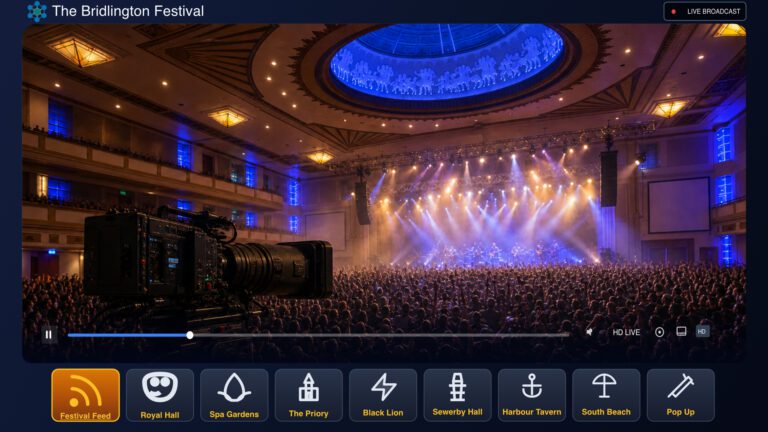
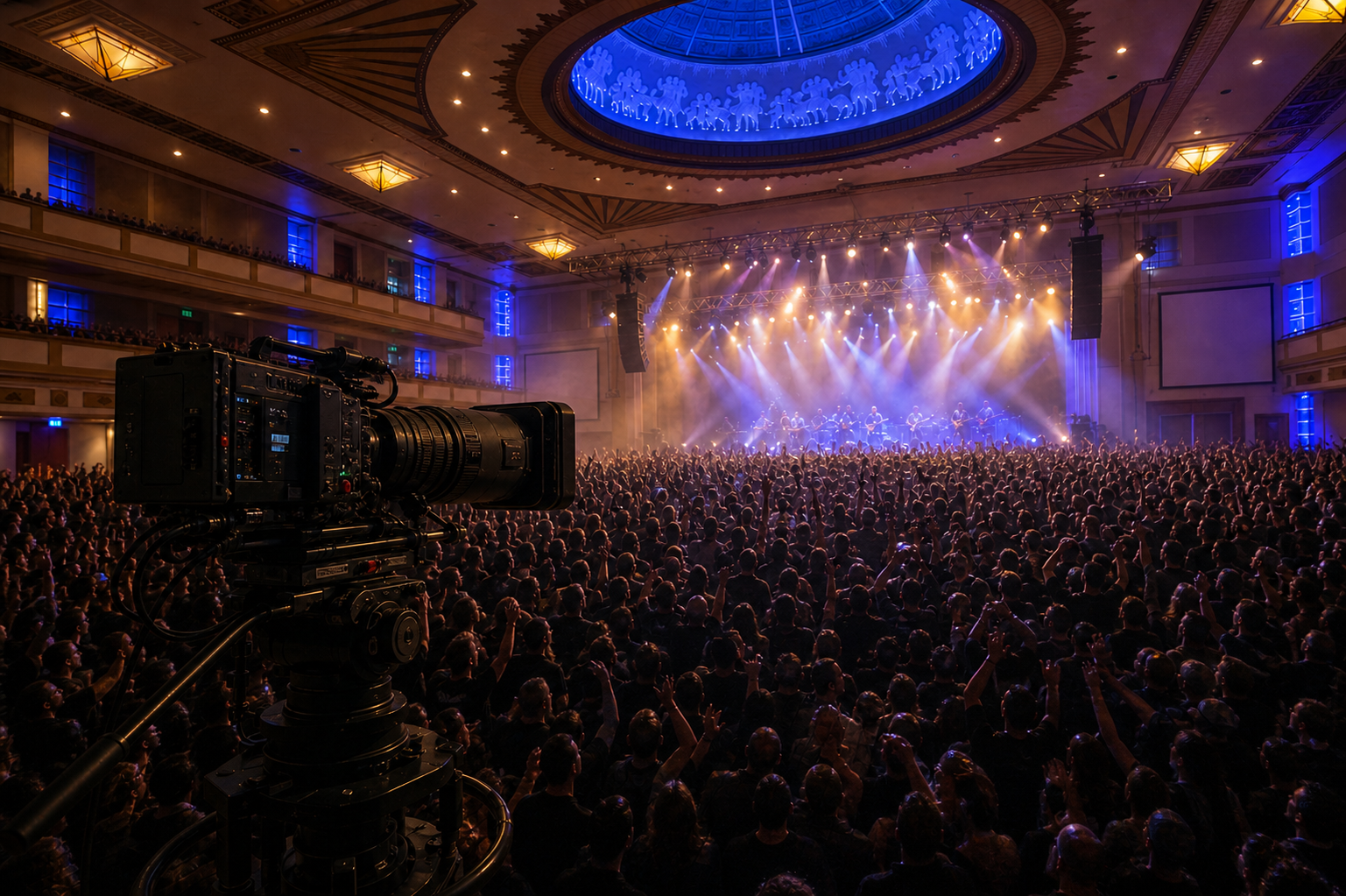
You enter beneath the Art Deco ceiling and the room makes its argument immediately. There is height above the audience, space around the stage and a sense of occasion built into the architecture. The inverted pyramid lights hang over the room like geometric details from another age, while the great circular ceiling feature gives the hall a visual centre even before the stage is dressed. It is a room designed to hold attention. Even empty, it has the visual grammar of a headline event: the stage is a destination, the audience is part of the picture, and the ceiling gives every sound and movement a larger sense of scale.
Their Website used to describe it as a restored 1930s Art Deco ballroom, with a domed glass ceiling and original décor lovingly restored (until they revamped the website – thank you wayback machine). It lists 1,250 square metres of exhibition space, a six-metre-wide first-floor balcony and a theatre capacity of 1,700 (which I think has been bumped closer to 3,000 standing since then). It also notes natural light, vehicle access, full technical facilities and hardwired three-phase power. Those details matter to the build. This is not a small black-box room that happens to contain a stage; it is a substantial public space with a serious audience footprint and the infrastructure to host a demanding event.
The brochure’s reference to natural light describes what the building can offer, not necessarily what the audience will experience during a show. In practice, the bay window and the ceiling dome are usually covered for events, removing daylight and giving the lighting designer control of the room. That makes the hall behave much more like a theatrical environment once the doors open: the architecture remains visible, but the exposure is shaped by the production rather than by the changing sky outside.
That grandeur is an advantage for the live audience. For a broadcast, it is also a set of demands.
A camera cannot simply arrive, find the nearest clear patch of floor and point towards the performers. The room has too many relationships that need to be preserved. The stage must feel large without making the performers insignificant. The audience must feel present without becoming an obstruction. The pyramid lights, ornate ceiling lines and central circular feature can provide a beautiful sense of place, but only if the exposure and framing allow them to remain part of the image rather than turning into distracting bright shapes.
The Royal Hall is already telling a story. The production has to learn how to film it without flattening it.
The room is beautiful, and unforgiving
Large rooms are often easier to describe than to cover.
From the back of the hall, the stage may look comfortably visible to the eye. A person can stand there and feel that they have a clear view. A camera is less forgiving. It needs a line that remains usable when people stand up, when lighting changes, when a performer moves across the stage and when the director wants a shot that is more specific than “the whole room.”
The difference between seeing the stage and covering the stage is the difference between being present and being responsible for the picture.
The website plan gives the production something more useful than the word “large”. It shows a main floor approximately 25 metres across at one point and 30 metres deep, with the wider hall extending to roughly 34 metres across and 44 metres in overall length. It also identifies a ceiling height of approximately 10.3 metres beneath the dancefloor, falling to around 2.6 metres beneath the balcony. Those changes in height are not just architectural notes. They divide the room into different production environments.
The Royal Hall needs positions that can see through the room without taking the room away from the people who paid to be in it. That is why the long-lens design matters before we have discussed a single specification. A camera close to the stage can produce intimate images, but it also occupies valuable space, creates sightline problems and changes the experience for the audience around it. A camera too far back protects the room but risks making the performance feel remote.
The answer is not one perfect position. It is a set of positions that gives the director choices.
Four cameras allow the production to preserve the architecture while still finding the event inside it. A wide can establish the relationship between performer and room. A side position can give the stage depth and movement. A long lens can isolate a singer, instrumentalist or presenter without asking the audience to look around a camera platform. Another position can protect the cut when one angle becomes unusable or when the performance demands a detail that the main cameras cannot safely reach.
This is coverage as spatial design.
The audience has paid for the view
There is a temptation in broadcast planning to treat the audience as an empty gap between the camera and the stage.
The Royal Hall makes that temptation impossible to ignore.
The people in the room are not background scenery. They have bought tickets, chosen their seats and arrived expecting the performance to happen in front of them rather than in front of a wall of equipment. A camera plan that produces a wonderful stream while making the room worse is not a successful main-stage plan.
That is why the positions need to be negotiated with the venue, the stage manager and the audience experience from the beginning. A pedestal needs space to move safely. An operator needs room to stand and work. A cable path needs to avoid aisles, emergency routes and the places where crew will be carrying cases after the audience is inside. A long lens needs a clear line, but the line cannot be created by taking the best seats out of service without understanding what that does to the room.
The production is part of the event’s physical choreography.
The four Vario Ped 1–70 pedestals are important in this context because they describe a controlled camera environment rather than a collection of improvised tripods. The cameras can occupy planned stations. Their height and movement can be considered in relation to the people behind them. The operators can rehearse where a move begins, where it ends and what happens if the director calls for a different shot while the pedestal is already in motion.
The long lenses extend that discipline. They allow the production to stay back, but distance does not remove the need for precision. It increases it. At a very long focal length, a small physical change can transform the frame. A performer’s face can move out of the intended composition with a shift that would barely matter on a wider lens. The operator must know not only where the performer is, but where the frame will be when the performer moves.
A respectful camera position is not automatically an easy camera position.
The balcony creates another layer of possibility. It can offer elevated audience views, a technical position or a way to see over the main floor, but its six-metre width does not turn it into unlimited production space. Access, loading, operator comfort, cable routes, structural limits and the view of the audience below all have to be considered. A position that looks perfect on the plan can be unworkable once a camera, a lens, an operator and the public are occupying the same building.
The programme begins before the show
The Royal Hall’s headline value is not limited to the evening performance.
The room may host the acts that define the festival schedule: the evening anchor, the large band, the finale, the presenter whose appearance connects several parts of the event, or the performance that the organisers already know they will want to revisit. Those moments need to work in real time, but they also need to survive as material.
That changes the way the venue is planned.
The production is not only asking, “Can we get a good live shot?” It is asking, “Will we have enough clean, consistent and well-identified material to make something useful tomorrow?”
That might mean a full on-demand version of the performance. It might mean a shorter festival film, a highlights package, an artist reel or a future programme that returns to the event months later. The camera plan therefore has to think beyond the cut being made by the director in the moment. A shot that is perfect for the live programme may not be the only material worth protecting.
This is one reason the Royal Hall’s camera bodies and lenses should not be judged only by the final stream. Their value also sits in the material they preserve for later decisions. The live audience receives one version of the performance. The archive gives the festival the possibility of making another.
The room is therefore both a stage and a source of future editorial choices.
Light, architecture and exposure
The Royal Hall’s visual character creates an exposure problem before the lighting designer adds a single cue.
The inverted pyramid lights, pale architectural surfaces and bright stage fixtures can exist in the same frame as a dark audience. During an event, the pyramids and the fixed lights built into the wall panels can be turned off or dimmed. The lighting in the dome and the wall panels can also become part of the show: they can change colour and are controllable from the lighting console. The dome is therefore not only an exposure problem or a piece of heritage architecture; it can become a large overhead production surface, changing the visual identity of the room behind the performers.
A performer may step from a pool of light into a less generous part of the stage. A lighting look may be beautiful in person but difficult for a camera to hold when it includes bright practicals, deep shadows, moving colour and a changing architectural background. The room can change mood faster than the camera operator can change position.
This is where the production needs a conversation between venue, lighting and camera departments rather than a late request for the shader to “make it work.”
The camera shader has to keep four sources visually related while the room changes around them. The director needs to know which cameras are clean and which are approaching a limit. Operators need to understand the intended looks so that they can frame for the light rather than discovering its consequences in the multi-view. The lighting department needs to know when a camera position is relying on a particular level of contrast or when a practical fixture is becoming a distraction in a long-lens shot.
None of this means the Royal Hall should be lit like a television studio. The point of the production is to preserve the venue’s identity. The Art Deco geometry should remain recognisable, the pyramid lights should still belong to the room, and the stage should still feel like a live performance space. The broadcast should not replace the hall with a generic image that could have been made anywhere.
But “cinematic” is not a substitute for exposure discipline.
The four large-format cameras can give the production latitude, but latitude is not permission to ignore the lighting environment. The final programme still has to remain coherent from shot to shot. A beautiful wide that contains the architecture, a close-up that isolates the performer and a side angle that catches the room’s depth must feel as though they belong to one event.
That coherence is made in rehearsal as much as in the grade.
A room with a running order
The Royal Hall also has a different relationship with time.
At a smaller venue, the production may be able to absorb a late change because the number of people and signals involved is limited. In the Royal Hall, a change to the running order can travel through the whole operation. A presenter may need a different camera position. A band may require additional playback. A guest appearance may alter the stage blocking. A finale may introduce lighting, pyrotechnic or audience moments that were not present during the afternoon rehearsal.
The venue plan therefore has to include more than where the cameras stand. It needs to include where the people stand, where they move, when the lights change and what the director expects to see at each point in the show.
The four camera positions should have primary uses, but they cannot be rigidly trapped by them. The master wide must remain available when everything else becomes busy. The detail camera needs enough flexibility to find the moment rather than only repeat a pre-planned shot. The side positions need to understand how their backgrounds change when the stage is reconfigured. The shader needs the lighting plan. The recording operator needs source labels that remain useful when the schedule changes.
This is why the Royal Hall will need a proper camera blocking rehearsal rather than a quick line check. The production has to test the room’s geometry while there is still time to move a pedestal, change a cable route or renegotiate a sightline.
The audience should never know that this work happened.
That is the measure of success.
The Spa Theatre connection
For me, the Royal Hall is not an anonymous grand room selected because it sounds impressive on paper. The Spa has its own memory and character. It is a place where the architecture is part of the experience, where the room can make an event feel larger than the equipment surrounding it, and where a production has to respect the fact that the audience is there to inhabit the space as much as to watch the stage.
That history matters to the design.
The Royal Hall should not be treated as a blank container into which the most expensive equipment can be poured. When I worked there for a few years, I saw this happen over and over again with acts doing tors and shoehorning their gear in. Its proportions, audience relationship and visual identity should determine the camera plan. The system has to belong to the room. The room should not be forced to behave like a studio simply because the production has arrived with a studio-sized budget.
This is also why the build is more interesting than a list of premium specifications. The question is not whether the URSA Cine cameras can produce an impressive image in isolation, or whether the Duvo lenses are extraordinary pieces of glass. The question is how those tools let the production reveal this particular room without interrupting it.
The architecture gives the programme its sense of occasion. The camera system has to make that feeling available to the viewer at home.
The venue’s technical infrastructure also changes the conversation. Hardwired three-phase power means the Royal Hall is not being treated as a temporary field site that must generate its entire electrical life from scratch. That does not make the production’s power demand disappear; the ATEM, 100G switching, recording, monitoring, audio, lighting and camera positions still need a properly distributed and protected supply. It does, however, give the flagship build a fixed venue resource to plan around. The question becomes how to use that supply responsibly, how to distribute it safely and how to keep critical production systems protected when the room is also powering the rest of the event.
The venue sets the terms
By the time the first case is opened, the Royal Hall has already made several decisions for us.
The audience needs clear sightlines. The stage needs coverage from more than one direction. The cameras need stable positions with enough room for operators to work. Long lenses need careful focus and movement. The lighting needs to be treated as a shared system rather than a problem handed to the shader. The running order needs to be rehearsed through the positions, not simply read out at the production meeting. The archive needs to be considered before the first record button is pressed.
This is why the venue portrait comes before the technical biographies.
If we begin with the camera body, we risk believing that the camera is the design. If we begin with the room, the camera becomes what it should be: a solution to a physical and editorial problem.
The Royal Hall is beautiful. It is also deep, bright, dark, busy, public and unforgiving. It rewards a production that plans its sight-lines and exposes its compromises early. It punishes a production that assumes the audience will make room, the lighting will behave and the network will somehow sort itself out once the equipment is powered.
The Beast has to fit inside that reality.
Chapter 3: The Camera Beast — URSA Cine, Duvo and Pedestal
The camera list for the Royal Hall is easy to read and difficult to understand.
Four Blackmagic URSA Cine 12K LF cameras.
Four Fujinon Duvo HZK 25–1000mm f/2.9–5.0 PL box lenses.
Four Sachtler Vario Ped 1–70 pedestals.
Four focus demands and four zoom demands.
On paper, that looks like four identical lines repeated until the budget becomes enormous. In the room, it becomes four complete camera positions, each one carrying a view of the show and a set of physical responsibilities. The body, lens, support, operator controls, cable route, lighting environment and sightline all have to work together. If any one of those elements is treated as an afterthought, the price of the lens will not rescue the picture.
This is the first place where the word “Beast” earns its name. The Royal Hall is not receiving four cameras. It is receiving four camera departments in miniature.
The camera is not the programme feed
Before looking at the URSA Cine, it is worth separating two things that equipment lists often blur together: the image the camera can acquire and the image the viewer will receive.
The Blackmagic URSA Cine 12K LF is a large-format cinema camera. The standard model is built around a 35.64 by 23.32 mm RGBW sensor, with Blackmagic specifying 16 stops of dynamic range. It can record a range of high-resolution formats, including 12K, and it includes built-in neutral-density filters for managing exposure in changing conditions. That is an impressive acquisition platform.
The Royal Hall programme, however, is not going to the audience as a 12K cinema file. The live production will be cut, mixed with audio, monitored, recorded and eventually encoded for delivery. The contribution stream to the Central Production Hub will be an SRT feed from the venue. The audience may watch that feed on a screen that cannot display the original acquisition resolution, let alone preserve every stop of dynamic range.
That does not make the 12K capability pointless. It changes where its value survives.
Some of it survives in the live image through the quality of the camera’s sensor, lens and processing. Some of it survives in the ability to frame and expose the scene with more information than the final delivery can carry. Much of it survives in the local recordings, where the festival can later make choices that were impossible during the live cut. A clean close-up that was not used in the programme may become valuable in the on-demand edit. A wider frame may allow a post-production crop. A performance may be revisited in a future festival film without being limited to the exact composition chosen under live pressure.
The camera is therefore doing two jobs at once. It is feeding tonight’s programme and protecting tomorrow’s options.
Technical Biography: Blackmagic URSA Cine 12K LF
The standard URSA Cine 12K LF has a PL lens mount, high-resolution acquisition formats, built-in ND filters and a 10Gb/s RJ45 Ethernet connection. That Ethernet connection supports file sharing, web media management, camera control and streaming workflows. It is important, however, not to confuse this standard camera with the newer URSA Cine 12K LF 100G variant, which has a 100Gb/s QSFP28 connection and is specifically documented for SMPTE 2110 IP video.
That distinction matters to this post. The Royal Hall is using the standard 10G camera path. Each camera’s 10G Ethernet connection feeds the Studio Bridge 10G PWR, which then provides the contribution link into the wider production network. The cameras are not being treated as direct 100G SMPTE 2110 sources into the ATEM.
At the same time, the cameras record at 12K for post-production. The live contribution and the post-production recording are therefore two related but separate jobs. The Studio Bridge carries the live camera path; the camera’s own recording preserves the high-resolution material for the later edit, including the 4K on-demand version.
Why 12K belongs here
The argument for 12K at the Royal Hall is not that the festival audience needs to watch a 12K stream.
It is that the flagship stage has enough visual and editorial value to make high-quality acquisition useful even after the live feed has been reduced for delivery.
The room is large. The performers may occupy only a small part of a wide composition. The director may want an intimate shot without placing a camera in the audience. The archive may need to support a later crop, a different aspect ratio or a new edit. A camera with substantial acquisition latitude gives the production more material to work with before the programme reaches the constraints of streaming and distribution.
That benefit is most obvious in the difference between a live decision and a post-event decision. During the performance, the director has to choose. A detail shot is either taken or missed. A wide shot either includes the right part of the stage or it does not. The ISO recording changes that relationship. It allows the festival to return to material that was captured but not selected in the live moment.
The 12K label can become a distraction if it is treated as the entire creative argument. It is not. The larger point is that the Royal Hall is the one venue in the mesh where the production is justified in recording more information than it needs for the immediate broadcast. The live feed can be shaped for the audience in the moment while the 12K files remain available for the edit afterwards.
There are limits, of course. The final stream cannot restore detail that was discarded during acquisition, but it also cannot create detail that was never captured. The quality of the lens, the discipline of focus, the lighting, the operator and the recording workflow remain more important than a number on the camera body. High-resolution acquisition is headroom. It is not a replacement for a good shot.
The lens is the real statement
If the cameras announce the ambition of the Royal Hall, the Fujinon Duvo lenses explain it.
Four HZK 25–1000mm f/2.9–5.0 PL box lenses represent a huge proportion of the budget. They are also the equipment that most directly changes where the cameras can live.
A camera position close to the stage can make a performer feel immediate, but it occupies space and affects the audience. A camera position at the back of the hall protects the room but risks reducing the performer to a small figure inside a beautiful wide shot. The Duvo’s range gives the production a way to work from farther away while still reaching into the performance.
That is not just a matter of magnification. It changes the geography of the production.
The camera can remain behind the audience or at the edge of a sightline. It can use the architecture as context when the director wants the room, then isolate a singer, drummer, presenter or guest without physically moving closer. It can hold a face while the room falls away behind it. It can find a hand on an instrument or a reaction at the side of the stage while keeping the camera position out of the audience’s experience.
The lens allows intimacy at a distance.
That phrase can sound romantic until the operator has to hold a performer at the long end of the range. At 1000mm, the frame is sensitive to movement. A small pedestal shift, a change in operator posture or a performer taking one step can make the composition feel suddenly unstable. Focus becomes an active discipline rather than a setting. The operator needs a clear understanding of the stage, the performer’s blocking, the lighting cues and the director’s likely demands.
Long lenses also magnify the atmosphere between camera and stage. Heat, haze, smoke and moving light can become part of the picture. A beam that feels delicate to the audience can become a bright veil across a close-up. A little vibration in the floor can become visible movement. The camera operator is not simply selecting a focal length; they are managing the distance between the viewer and the performance.
Technical Biography: Fujinon Duvo HZK 25–1000mm
The build uses four PL-mount Fujinon Duvo HZK 25–1000mm f/2.9–5.0 box lenses. Their purpose in the Royal Hall plan is clear: long-range, operator-controlled coverage from positions that do not intrude on the stage or audience.
A lens can be optically appropriate and still create a poor live workflow if its control system does not integrate cleanly with the camera and operator position. The Royal Hall needs the operator to work focus and zoom with confidence, not to improvise a separate control arrangement halfway through the show.
The important creative point is secure: the four Duvo lenses are what make the Royal Hall’s distance workable. They let the production respect the room while still producing the close, specific images expected from a headline performance.
The pedestal makes the camera a position
The Sachtler Vario Ped 1–70 pedestals complete the physical argument.
A long lens on a fixed tripod can produce a stable image, but it does not automatically produce a flexible camera position. The Royal Hall needs cameras that can be placed, adjusted and, where appropriate, moved without becoming an obstruction or an uncontrolled risk. The pedestal gives the operator a working height and a planned physical relationship with the room.
The number “1–70” is not, by itself, a production plan. The pedestal still has to be loaded correctly, levelled, checked for travel and positioned where the operator can work safely. The combined camera, lens, accessories and support package must be within the appropriate operating limits. The floor must be suitable. The route must be clear. The move must be rehearsed.
This is where a pedestal differs from the romantic idea of a camera move. It is not simply a way to make the picture glide. It is a way to make the camera position repeatable.
The operator knows where the camera begins. The stage manager knows how much space the position requires. The director knows what kind of movement is possible. Engineering knows where the cable must travel. The audience sees a camera that seems to belong in the room rather than a piece of equipment that has been parked wherever there was space.
The pedestal also gives the camera a useful relationship with the balcony and changing floor levels. The main floor, the rear of the room and any elevated position do not necessarily offer the same operating height or sightline. A camera can be physically stable and still be visually compromised if it is placed behind the wrong row, beneath the wrong part of the balcony or on a route that the audience will constantly interrupt.
The support system is therefore part of the venue design.
Focus and zoom become a conversation
The focus and zoom demands are small items in the budget compared with the lenses, but they describe the way the camera positions are meant to be operated. The Royal Hall will use the Blackmagic controls deliberately, keeping the operator experience consistent across all the festival venues.
The operator is not expected to leave the camera and walk to the lens every time the director calls for a change. Focus and zoom have to be available at the working position, alongside the viewfinder, talkback and the physical awareness of the pedestal. The operator is balancing several forms of attention at once: keeping the subject composed, holding focus, responding to the director, anticipating the performance and remaining aware of the camera’s relationship with the audience.
At the long end of the Duvo range, the focus operator’s job becomes especially unforgiving. The performer may move towards or away from the camera. A lighting cue may change the apparent contrast around the face. A haze effect may soften the image without representing an actual focus error. A rapid zoom may alter the frame faster than the director’s next instruction can arrive.
This is why the demand should be understood as part of the operator’s language rather than as a convenience button. The camera, lens, pedestal and operator form one instrument. The quality of the live picture depends on how well that instrument has been rehearsed.
The important choice is operational consistency. A camera operator who has worked at the Priory or the Spa Gardens should not have to learn an entirely different focus-and-zoom language when they arrive at the Royal Hall. The lenses are much larger and the positions are more demanding, but the operator-facing controls remain familiar. That reduces friction during rehearsal and matters even more when a live cue arrives under pressure.
Four positions, four responsibilities
The Royal Hall does not need four cameras because the number four looks impressive in a budget table. It needs four because the room and the performance create more than one useful point of attention.
One camera can hold the relationship between stage and audience. This is the shot that rescues the programme when the performance becomes visually busy and reminds the viewer where they are. A second can work the stage from one side, giving depth and a different relationship with the performer. A third can mirror that coverage from the opposite side or protect a specific part of the performance. The fourth can carry the detail: the face, the instrument, the presenter, the reaction or the moment that turns a competent record into a living broadcast.
Those are provisional roles, not fixed assignments. The final plan depends on the Royal Hall’s actual floor layout, audience configuration, stage design, lighting positions and safe cable routes. A camera that is ideal for one headline act may be the wrong camera for a large band or a presentation with guests moving through the room.
The key is that the director has choices without forcing the audience to surrender the room to the production.
The four positions also create a form of editorial resilience. If one camera is unavailable, the programme does not automatically collapse into a single wide and a desperate crop. The remaining operators can protect the cut while engineering investigates. That is not the same as a fully redundant camera system; there are still only four primary camera bodies, and the kit list does not include a spare. It is simply more coverage and more operational headroom than the lower tiers can provide.
The shader sees the differences first
Four large-format cameras do not naturally produce four matching pictures.
They are pointed in different directions. They see different amounts of the stage, audience, ceiling and lighting. One may be looking into a bright practical. Another may be looking into a dark curtain. A third may be working with a performer under a narrow special. The operator may frame beautifully, but the sources still need to belong together when the director cuts between them.
That is the shader’s responsibility.
The camera shader watches the cameras as a group while also understanding the individual behaviour of each position. They work with exposure, colour and consistency. They know when a camera has a clean image and when it is approaching a limit. They communicate with the director and operators, and they provide the bridge between the creative intention of the shot and the technical condition of the source.
The ATEM Camera Control Panel exists for this role, but the panel is only useful when somebody has the time and knowledge to operate it. This is another reason the Royal Hall cannot be treated as a more expensive version of the Black Lion. The equipment list creates specialist work. It does not remove it.
The shader also becomes one of the people who protects the venue’s identity. If the dome lighting changes colour, if the wall panels become part of a look or if the stage lighting moves from a bright performance state to a darker presentation state, the cameras need to remain related. The goal is not to flatten every source into identical neutrality. It is to keep the cut intentional.
The camera chain is a promise, not a shopping list
By the end of this chapter, the camera system should feel less like a collection of premium objects and more like a chain of dependencies.
The URSA Cine cameras provide the acquisition platform, but the final model affects the live IP path. The Duvo lenses provide the reach, but their control configuration affects the operator’s ability to work. The pedestals provide stable physical positions, but their usefulness depends on the floor plan, sightlines and rehearsal. The demands provide focus and zoom control, but only after compatibility is confirmed. The shader provides consistency, but only if the production gives that role a dedicated place in the crew.
The camera is not finished when it is on the pedestal.
It is finished when it has a safe position, a clear route, an operator who knows the room, a lens that can be controlled, a picture that can be matched, a signal path that has been tested and a recording destination that is ready to preserve what the live cut does not use.
That is the camera beast.
It is expensive, physically large and technically demanding. More importantly, it is honest about what a headline production asks of a room. The Royal Hall needs to get close without becoming intrusive, hold detail without losing stability and protect the performance beyond the few seconds in which the director chooses a shot.
The glass can reach the stage from the back of the room.
Now the production has to provide the people who can use it.
Chapter 4: The Crew Is the System
There is a dangerous moment in a large equipment plan when the hardware begins to look more complete than the production.
The racks are specified. The cameras have been chosen. The lenses are in the budget. The network has enough capacity on paper. Somebody looks at the total and says, “That should cover it.”
It does not cover it.
The Royal Hall only becomes a production when people are assigned to the decisions the equipment creates. Four cameras mean four operators. A large-format camera chain means somebody has to match the pictures. A four-M/E switcher means somebody has to understand what those M/Es are being used for. An ISO recorder means somebody has to know what is being recorded, whether it is healthy and what happens when the live show moves faster than the archive plan.
The hardware is impressive because the work is serious. It is not a substitute for the work.
The Royal Hall roles
The central production team begins with the director. The director is responsible for the programme as a piece of television: the pace, the emphasis, the relationship between performer and room, the decision to hold a shot or cut away, and the awareness that the live audience and the remote audience are watching different versions of the same event.
Beside the director is the technical director, or vision mixer, operating the ATEM. This is the person who turns the director’s decisions into the programme output. They need to know the panel, the sources, the M/Es, the keyers, the multiviews and the state of the show. They also need enough awareness of the system to recognise when a source has failed before the director asks for it.
The camera shader has a separate responsibility. They are not there to choose the shot. They are there to make the four cameras behave as one visual system: matching exposure, colour and image consistency while the Royal Hall lighting changes around them. The shader watches the technical condition of the sources so that the director can concentrate on the editorial cut.
Then there are the four camera operators, each working a dedicated position. They frame, focus, zoom, move where appropriate, listen to talkback and anticipate the performance. They are also responsible for understanding the physical space around their camera. A shot is not successful if it is beautiful but blocks a public route, crosses a safety boundary or cannot be held when the audience moves.
The audio team carries another complete set of decisions. The front-of-house engineer is responsible for the room. The broadcast audio engineer is responsible for what arrives at the viewer. Those two mixes may share sources, but they do not have identical priorities. The room can tolerate a balance that feels exciting at the stage. The broadcast mix has to remain clear on headphones, televisions, laptops and phones, often with less physical energy to support it.
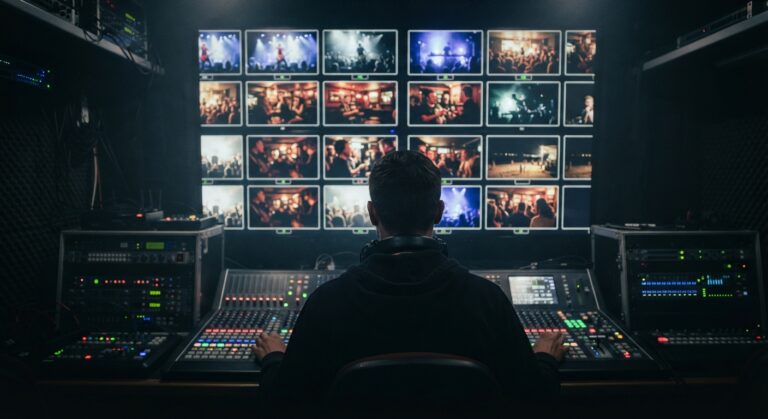
The playback and graphics operator handles the material that is not being created by a camera at that instant: titles, sponsor material, holding slides, walk-on content, stings, VT and emergency sources. The recording engineer watches the programme and ISO records, checks that storage and file paths are behaving, and understands what material must be protected if the show is later turned into a 4K on-demand version.
The network and broadcast engineer looks after the environment that connects these jobs. The media paths, control paths, PTP timing, NMOS registration, conversion equipment and contribution route all need somebody who understands their condition. A network engineer who only appears when the picture has already disappeared is not a resilience plan.
The stage manager coordinates the room itself. They know when the band is ready, when a presenter is moving, when a camera position is about to become unsafe and when the running order has changed. The production coordinator holds the wider plan together: crew calls, access, rehearsals, venue liaison, cases, catering, permissions, schedules and the thousand details that determine whether the technical plan can actually be built.
None of these roles is ornamental. Each one prevents a different kind of failure.
Why the roles separate
At the Harbour Tavern, combining jobs may be the only sensible way to operate. At the Black Lion, a small team can still work efficiently because the system has a limited number of moving parts. That does not make the people less skilled. It makes the scale appropriate to the venue.
The Royal Hall changes the calculation.
If the director is also trying to shade four cameras, they are not fully watching the cut. If the technical director is also monitoring ISO storage, they are not fully watching the switcher. If the audio engineer is expected to manage Dante routing while mixing a headline performance, they are being asked to divide attention at exactly the moment the mix becomes most demanding. If the network engineer is also the only person who understands the camera contribution path, the production has created a single human point of failure.
The larger system is not automatically safer. It becomes safer when the work is separated clearly enough for people to do it properly.
This separation also improves communication. The director can say, “Take camera three,” without needing to explain the exposure condition of the source. The shader can say, “Camera two is approaching a problem,” without trying to make the editorial decision as well. The network engineer can report that a path has failed and identify the affected sources while the director chooses how to cover the moment. The audio engineer can protect the programme mix while the front-of-house team manages the room.
That is what specialist roles buy: not prestige, but attention.
The operator experience must remain familiar
The Royal Hall’s camera positions are larger and more demanding than those at the smaller venues, but the operator should not feel as though they have arrived in a different profession.
The decision to use Blackmagic Focus and Zoom Demands is part of that continuity. Operators who have worked elsewhere in the Festival Mesh should recognise the control language. The lenses are bigger, the distances are longer and the consequences of a mistake are more visible, but the basic relationship between hand, control and image remains familiar.
That matters during a festival. Crew do not arrive as blank slates for every venue. They carry habits, muscle memory and shared vocabulary from one stage to the next. A consistent control approach reduces the amount of attention spent learning equipment and increases the attention available for the performance.
Consistency is not the same as uniformity. The Royal Hall still needs operators capable of working a very long box lens from a pedestal. It still needs people who understand the different visual behaviour of the room, the demands of long-range focus and the way the lighting can change the picture. But they can bring an established operating language with them.
That is a quiet form of resilience. Familiarity reduces hesitation.
Communications and cueing
A live production is a conversation conducted at speed.
The director calls the cut. The operator responds. The shader warns of a camera condition. The stage manager tells the control room that the presenter is moving. Audio calls for a level or protects a cue. Playback waits for the correct moment. Engineering reports a path condition without flooding the rest of the crew with information they do not need.
If everybody talks at once, the system becomes less intelligent than the equipment it contains.
The Royal Hall therefore needs a communications plan that is simple enough to use under pressure. The director needs a production channel. Camera operators need camera calls and relevant stage information. Audio, playback, engineering and stage management need routes that let them coordinate without burying the main cut in unrelated traffic. The precise intercom equipment is not the glamorous part of the build, but the language and routing are essential.
The same applies to tally. A camera operator should know when their source is on programme, when it is in preview and when it is available for the director. The shader needs to understand the operational state of the cameras. The stage team needs to know when a position is live and should not be crossed.
Good communications do not make the show feel busy. They make the show feel calm.
Rehearsal is infrastructure
The Royal Hall cannot be commissioned by powering everything on and asking whether the picture appears.
The rehearsal has to test the system as a set of human actions.
The camera operators need to block their positions. The director needs to understand what each camera can offer. The focus and zoom demands need to be used through actual performance movements rather than tested only on a static chart. The shader needs to see the architectural lighting looks, including the dome and wall-panel colours. The audio team needs to test the difference between the room mix and the broadcast mix. Playback needs to run every important clip. Recording needs to prove that the intended programme and ISO sources are arriving where expected.
Engineering needs to introduce controlled failures.
What happens when a camera source disappears? Who notices first? Who tells the director? Which source covers the gap? Does the control room know whether the problem is at the camera, the Studio Bridge, the network switch or the ATEM? If the SRT contribution is interrupted, does the Royal Hall continue recording locally? If a monitor fails, does the person who relied on it have another way to see the information they need?
These tests should not be theatrical exercises designed to frighten the crew. They are how the crew learn the shape of the system. A failure that is rehearsed becomes a procedure. A failure that is never discussed becomes an argument in real time.
The venue’s hardwired three-phase power should be part of this preparation too. The production needs to understand what is supplied, where the distribution is placed, what is protected and how the critical racks behave if the event power configuration changes. Power is not a detail to be left until the cases arrive. It is part of the Royal Hall’s operating environment.
The human redundancy question
It is easy to talk about redundancy as though it only belongs to networks.
The Royal Hall’s most important spare path may be a second person who understands the job.
A cable can be replaced. A switch can be restarted. A preset can be reloaded. But if one person is the only person who knows how the system was built, what the labels mean or which compromise keeps the show alive, their absence can be more damaging than a failed piece of hardware.
That means the main-stage system needs documentation that is usable by the crew, not merely impressive to somebody reading the design after the festival. Source names should make sense. Camera positions should be marked. The running order should identify critical cues. The recording plan should explain what is being protected. The failure plan should be close enough to reach and short enough to read.
It also means handovers matter. A crew member coming on for the evening shift needs to understand the condition of the system, not just receive the instruction that “everything is fine.” The person leaving needs to be able to explain what has changed, what remains uncertain and which sources require attention.
The Royal Hall is too important to be a one-person secret.
The system disappears when the crew works
The audience will never see the camera shader matching four sources. They will not see the director choosing a cut while engineering watches a network path. They will not hear the stage manager cueing a presenter or the recording engineer checking that the ISO remains healthy.
That hidden work is the point.
When the crew is working well, the equipment disappears into the performance. The director can concentrate on meaning. The operators can concentrate on the performers. Audio can protect clarity. Engineering can manage the system before a fault becomes a crisis. The audience sees a headline show that feels inevitable, as though the room naturally produced the picture.
It did not.
The picture was built by a group of people who understood their own responsibilities and the responsibilities around them. The Royal Hall’s expensive equipment gives them room to work, but the crew gives the equipment purpose.
The next step is to connect those positions together: not as a collection of camera cables, but as the 100G production heart that allows the whole room to behave as one system.
Chapter 5: The 100G Heart — Royal Hall IP Production
The word “IP” can make a production sound abstract.
At the camera position, there is still a person, a lens, a pedestal and a performer. In the control room, there is still a director looking at a multi-view and calling for camera three. In the audience, there is still a room full of people waiting for the next song. The network does not replace those physical realities. It gives the signals between them a more flexible home.
The Spa Gardens introduced us to the idea of a full IP production. The Royal Hall applies that idea under more pressure. There are more high-value sources, more destinations, more recording, more monitoring and more reasons to keep the production alive when one path becomes unavailable.
The central system is built around the ATEM 4 M/E Constellation IP Plus and the Blackmagic Ethernet Switch 820. The switcher makes the programme. The switch provides the media fabric around it. The Studio Bridge 10G PWR brings the four camera contribution paths into that environment. The SDI Expander 8x12G gives selected legacy and monitoring devices a way in and out. The timing and control connections keep the networked signals behaving as a production rather than as a collection of unrelated data streams.
The result should feel simple at the point of use.
The director sees sources. The shader sees cameras. The recording operator sees records. The engineer sees paths. Underneath those views, the system is moving a great deal of information very quickly.
From the Spa Gardens to the Royal Hall
The Spa Gardens proved that an IP production could be local, practical and professional. It did not require every signal to leave the venue as a conventional SDI chain, and it did not require the whole town to be joined by a private 100G network. Its production network ended at the venue boundary, with the finished programme sent onwards as a contribution stream.
The Royal Hall follows the same broad principle. Its 100G fabric is local to the venue. It is not a secret extension of the festival’s backbone, and it does not make the public internet behave like a broadcast network. The Royal Hall makes its programme inside the building, records what it needs to preserve and then packages the finished output for the Central Production Hub.
That separation is important.
Inside the hall, the production can design around uncompressed or lightly processed media, multicast routing, PTP timing and equipment that understands SMPTE 2110. Once the programme leaves the hall, it becomes a contribution service with different constraints. SRT provides a way to move the finished programme over the available network connection, but it is not the same thing as extending the Royal Hall’s internal media fabric across the town.
The venue’s network ends at the venue rack.
That is not a limitation to apologise for. It is a sensible boundary. The Royal Hall needs a strong local system because it is responsible for making a strong local programme. The hub needs a reliable contribution from that programme because it is responsible for bringing the venues together.
The switcher at the centre
At the centre of the Royal Hall is the ATEM 4 M/E Constellation IP Plus. It is important to describe it accurately because it is not an SDI production switcher with an IP connector attached. It is a native SMPTE 2110 switcher.
The specification provides 64 IP inputs and 64 IP outputs, with sixteen 100G QSFP28 IP network connections. It supports NMOS control and PTP reference connections, and it can use SMPTE ST 2022-7 protected delivery across two 2110 networks. It also provides the internal production resources expected from a flagship vision mixer: four M/Es, advanced keyers, multiviews and SuperSource capability.
The distinction between inputs and outputs is more useful than the raw numbers. The Royal Hall does not need 64 sources simply because the number exists. It needs enough capacity that camera feeds, programme outputs, clean feeds, previews, multiviews, records, playback, conversion paths and future additions do not all compete for the same narrow set of connections.
Headroom is operational freedom.
With a smaller switcher, every additional source can become a negotiation. Which output is sacrificed for a new multiview? Which return feed is removed to make room for a playback source? Which monitoring destination is shared because the hardware has run out of routes? The four-M/E Constellation IP Plus creates space for the director to build layers and programme structures without treating every new requirement as a crisis.
That space still needs to be managed. A large switcher can produce a large mess if its source labels, M/E assignments and output plan are unclear. Capacity does not remove the need for a routing map. It makes a routing map more important because more options are available.
The ATEM also has no SDI inputs or outputs. That fact shapes the whole Royal Hall design. An SDI source cannot simply be plugged into the back of the switcher because the switcher is not waiting for that kind of connection. The source needs to be converted into the IP environment, or the destination needs to be converted back out of it. The SDI Expander exists because an all-IP core can still have useful SDI edges.
The switcher is therefore the heart of the media production, but it is not the entire body. It needs the switch, timing, control, conversion and operator interfaces around it.
The camera path into the heart
The four URSA Cine 12K LF cameras use their 10G Ethernet connections for the live contribution path. Those connections feed the Studio Bridge 10G PWR, which then provides the route into the production network.
This gives the Royal Hall a useful separation between acquisition and contribution. The cameras record at 12K for post-production, while the live system receives the camera material needed for the programme. The live path does not need to pretend that the contribution stream is the same thing as the high-resolution master material. Each serves a different purpose.
The contribution path is about getting a usable camera source to the director and the rest of the production. The local recording is about preserving the material for later editorial decisions. One is immediate and operational. The other is deliberate and archival.
That distinction also helps explain why the standard 10G camera model is appropriate here. The cameras do not need to be direct 100G SMPTE 2110 sources for the Royal Hall to have a 100G IP core. The Studio Bridge provides the point where the camera-side contribution connects with the larger production environment. The 100G fabric then carries the sources between the bridge, switcher, recorder, monitoring and conversion equipment.
The exact internal allocation of the bridge is part of the engineering build, but the conceptual path is clear:

The important thing is not that the diagram looks clean. It is that each connection has a defined job. The camera’s 10G link is not being described as a general-purpose route into every part of the festival. The bridge is not being treated as a magical replacement for network design. The switcher is not being asked to accept SDI that it does not physically have.
The system becomes understandable when the boundaries are respected.
The camera gateway
The Studio Bridge is the camera-side gateway in this build. It sits between the 10G Ethernet contribution from the URSA Cine cameras and the wider production network that feeds the Royal Hall’s IP core.
That makes it one of the most important pieces of equipment in the room even though it is not the headline product in the budget. It is where the camera positions stop being isolated stations and become production sources. If the bridge path is misconfigured, the ATEM may be perfectly healthy and still have no useful camera pictures to cut.
The bridge also gives the Royal Hall a cleaner operational boundary. The camera operators do not need to become 100G fabric engineers. They need a reliable camera connection, familiar controls and a clear indication that their source is available. The bridge and network team carry the responsibility for presenting those sources correctly to the production environment.
This is the kind of equipment that can disappear when it works. Nobody watching the programme will know that a bridge carried the camera source. Everyone in the control room will know if it stops doing so.
The 100G fabric
The Ethernet Switch 820 provides the local 100G transport layer. It has eight 100G QSFP28 ports, two 10G RJ45 ports and separate connections for NMOS control, PTP reference and management. It also has dual power supplies and front-to-back cooling, which matter in a rack that will be carrying high-bandwidth media continuously through a long festival day.
The switch is not simply a bigger version of an office network switch. The media fabric has to move the right streams to the right places, maintain timing and support the operational model of a live production. The network engineer needs to understand which traffic is media, which is control, which is timing and which is ordinary management. If all of it is treated as the same kind of packet, the system becomes much harder to reason about.
The switch also supports the Royal Hall’s philosophy of local control. The venue does not need to send every camera signal to the hub and wait for a distant system to decide what the audience should see. It can make the programme locally, where the director, shader, audio engineer and stage team are close to the event. The hub receives the finished contribution and can combine it with the rest of the festival.
This reduces the distance between creative decision and technical consequence. If the director wants to change a source, the source is in the same venue. If engineering needs to inspect the camera path, the camera path is in the same venue. If the contribution to the hub fails, the Royal Hall can continue making and recording its own programme.
Media, control, timing and management
One of the easiest ways to make an IP system sound more mysterious than it is, is to describe every connection as “the network.”
The Royal Hall has several networks and services with different responsibilities.
The media fabric carries the production signals. This is the high-bandwidth environment around the cameras, switcher, recorder and conversion devices. It is where SMPTE 2110 sources and destinations are presented to the production.
The control network carries the information that lets people and systems manage those media devices. NMOS helps describe and control sources and destinations. Camera control travels as operational data rather than as the picture itself. The panel on the desk does not need to carry the full camera image just because it needs to change a setting.
PTP provides the common timing reference. In a live production, the sources have to agree on when a frame exists. The picture, audio, switching and recording systems cannot behave as independent clocks and still be expected to cut cleanly for hours. Timing is not visible when it works, but it is present in every clean transition.
The management network exists for the ordinary work of keeping equipment reachable, configured and monitored. It should not be confused with the media path simply because both use Ethernet.
The UniFi Pro XG 48 belongs in this wider support environment, alongside the Mac Studios, displays and ordinary data services. It should not be described as the switch carrying the 100G media core unless the final topology explicitly assigns it that role. The dedicated 100G media fabric has its own equipment and its own responsibilities.
This separation is not needless complexity. It is how the engineer can answer a useful question when something goes wrong: is the picture missing because the source has failed, because the media route is broken, because timing has drifted, because control is unavailable or because a display is simply no longer showing the information?
SDI at the edge
The ATEM’s native-IP design does not make SDI useless. It makes the position of SDI more deliberate.
The SDI Expander 8x12G provides eight independent 12G-SDI-to-2110 channels and eight separate 2110-to-12G-SDI channels, operating concurrently. In the Royal Hall, it is the edge of the IP system: the place where selected legacy sources, monitoring devices or delivery equipment can connect without changing the core architecture.
That gives the production practical options. The Media Player 10G can provide SDI playback outputs. The Streaming Encoder 4K accepts a 12G-SDI programme input. SmartView displays can be used as SDI monitoring destinations. The SDI Expander can provide the conversion between those devices and the native IP core.
This is not a failure of the IP design. A professional system is rarely improved by pretending that every useful device speaks the same protocol. The sensible approach is to keep the core coherent and provide controlled gateways at the edges.
The gateway also makes troubleshooting more structured. If a SmartView is blank, the engineer can work through the SDI output, the Expander channel, the corresponding IP source and the switcher destination. The problem has a path that can be followed. Without that discipline, “the monitor is black” becomes a vague room-wide emergency.
The two networks idea
The Royal Hall’s 100G fabric is powerful enough to encourage bad habits. It would be easy to put every device, every control function and every support computer onto the same convenient route and call the result efficient.
That would make the system harder to protect and harder to understand.
The production needs a media environment, a control and timing environment, and a management layer. They may share physical infrastructure in carefully designed ways, but they should not be described as one undifferentiated pipe. The media path has to be protected from ordinary support traffic. The control path has to remain available to the people operating the system. Timing needs to be visible and stable. Management access should not become a source of accidental disruption.
The distinction becomes even more important when the Royal Hall contributes to the hub. The internal 100G fabric is not the same as the SRT connection leaving the building. The programme is made locally, then encoded for transport over the available external network. A clean internal media environment does not guarantee an internet contribution, and a healthy SRT contribution does not prove that every local ISO path is working.
Those are separate services with separate failure modes.
SMPTE 2022-7 applied to the headline stage
The Royal Hall equipment supports protected IP delivery across two network paths in several important parts of the system. The ATEM, recorder, SDI Expander and UpDownCross units are capable of working with SMPTE ST 2022-7 redundancy.
The practical question is how much of that capability the finished installation actually deploys.
Redundancy is not created by writing “A” and “B” on two labels. It requires two appropriately designed paths, suitable optics or cables, correct switch configuration, timing, routing and a crew who understand what the system should do when one path disappears. The equipment can support the principle, but the physical Royal Hall design must give it somewhere to operate.
That is why the failure plan will need to talk about more than a spare connection. What happens when a path is damaged? Does the affected source remain available through the other path? Which alarms appear? Who is responsible for responding? Can the director keep cutting while the engineer repairs the failed route? Is the recorder still receiving what matters?
The most valuable redundancy is the kind that becomes boring. A path fails, the system continues and the audience never notices. The engineering team records the incident, restores the failed route and carries on with the show.
The programme leaves the hall
Once the ATEM has made the Royal Hall programme, the finished signal still has to leave the building.
The venue does not send its entire 100G production fabric to the Central Production Hub. It sends a contribution stream. The Blackmagic Streaming Encoder 4K takes a confirmed 12G-SDI programme feed, encodes it for SRT or RTMP delivery and sends the result over the external network.
Because the ATEM is native IP and the encoder is an SDI device, the programme needs a planned IP-to-SDI edge. The SDI Expander provides that kind of gateway within the overall build. The important point is that the conversion happens at the venue boundary, after the Royal Hall has made its production decision.
The hub therefore receives a finished Royal Hall service rather than four raw camera feeds. It can put that service beside the Priory, Spa Gardens, Black Lion and Harbour Tavern feeds. The individual venue retains responsibility for making its own programme, while the central operation gains a consistent contribution from each location.
That is the mesh working as intended: local intelligence at the venues, shared coordination at the hub.
A network that lets people think
The technical achievement of the Royal Hall is not that it has a 100G switch.
It is that the switch, timing, control, conversion and production systems allow the people in the room to think about the performance. The director can respond to a song rather than to the limitations of a route. The shader can watch the cameras rather than constantly rebuilding their connections. The recording operator can protect the archive while the live cut continues. Engineering can identify whether a problem belongs to media, timing, control or delivery.
The network is successful when it makes those decisions easier.
The camera sources arrive from the 10G Studio Bridge path. The 100G fabric carries them through the local production environment. The ATEM cuts the show. The SDI Expander connects the devices that still need SDI. Timing and control keep the system coherent. The recorder preserves the material. The encoder sends the finished programme to the hub.
The viewer sees none of this.
They see the Royal Hall.
That is the point of the 100G heart.
Chapter 6: Audio, Playback and the Show Between the Cameras
The Royal Hall could produce a perfectly routed picture and still fail as a broadcast if the sound is treated as something that happens somewhere else.
The audience does not experience a headline performance as four camera angles. They experience voices, instruments, applause, room, silence, playback, announcements and the energy that joins one moment to the next. The cameras can show a performer lifting a hand, but the sound tells us whether the room is waiting, singing, cheering or holding its breath.
At the smaller venues, the audio system had to be proportionate to the stage. At the Royal Hall, the audio system has to be proportionate to the number of things happening at once. The headline may have a full band, guest musicians, presenters, playback, walk-on music, audience microphones and a broadcast mix that must remain intelligible on a television or a pair of headphones.
The Yamaha Rio3224-D3 provides the stage-side capacity. Dante carries the sources into the wider audio workflow. Fairlight Live and the Audio Panel 40 give the broadcast engineer a dedicated place to build the transmitted mix. The front-of-house system remains responsible for the people in the room. Playback and graphics provide the material that is not being created live by the performers or cameras.
The principle is familiar from the Priory and Spa Gardens.
The scale is not.
The Stage Box belongs close to the stage
The Rio3224-D3 is not placed in the control room because that would be convenient for the engineer. It belongs close to the microphones, instruments and stage connections.
That keeps the analogue runs short and puts the conversion into the network at the point where the sources enter the production. The stagebox provides 32 analogue inputs, 16 analogue outputs and eight AES/EBU outputs, with Dante used to move the audio through the local network. It has the capacity to accept a serious headline-stage input list without forcing the production to build a separate analogue snake for every destination.
The real advantage is not simply the number of sockets.
It is what happens after the sources become network audio. The front-of-house engineer can subscribe to the channels needed for the room. The broadcast mix can receive the channels it needs for the audience at home. Monitor mixes, record feeds and communications can be planned separately. The same microphone does not have to become one compromise level for every listener.
The vocalist can be loud in the room without being allowed to dominate the broadcast. The drums can have physical impact in the hall while remaining controlled on a phone speaker. The presenter can be clear at home even when the stage is still carrying the energy of the previous song.
That is the difference between sharing sources and sharing a mix.
FOH and broadcast are different audiences
The front-of-house engineer is mixing for people surrounded by the room.
They hear the direct sound from the stage, the acoustic response of the Royal Hall, the audience reaction and the physical energy of the loudspeaker system. Their work has to make the performance feel immediate in that building.
The broadcast engineer is mixing for people who may be listening in a kitchen, on headphones, through a television soundbar or on a phone in a noisy room. They do not have the Royal Hall around them. They need the mix to create enough sense of place without relying on the venue to provide the balance.
The two engineers can share the same source material and still make different decisions.
That separation is one of the strongest arguments for the Rio and Dante workflow at this scale. The broadcast engineer is not simply taking a stereo output from the room and hoping it translates. They can receive the channels required to build a controlled programme mix. The FOH engineer can do the job of making the live room work without every change being judged by what it does to the stream.
There is still a relationship between the mixes. A stage change, a presenter arriving, a guest microphone being opened or a playback cue beginning can affect both systems. That is why communications between FOH, broadcast and stage management matter. Separation should create independence, not isolation.
Fairlight at headline scale
The Fairlight Live Audio Panel 40 gives the broadcast engineer a physical place to work. It provides 40 motorised faders and four large touchscreen displays, with access to the layers, buses, matrices, auxiliaries, VCAs, submasters and talkback that become useful when the show has more than a handful of sources.
The important thing is not that the panel has more faders than the smaller venue panels. It is that the larger surface lets the engineer organise the mix around the show.
One layer can hold the main band inputs. Another can group presenters and guests. Another can carry playback and sponsor material. VCAs can give the engineer control of families of sources without losing the ability to reach an individual channel when a problem appears. Buses and submasters can create structure between the channel strip and the final programme output.
This is the point at which a mouse becomes a poor substitute for a console. Software remains powerful and useful, but a live mix benefits from a physical relationship with the decisions. The engineer can ride a vocal while watching the meters, open a presenter, protect a playback cue and keep one hand near the programme bus without hunting through windows.
The panel does not mix the room by itself. It does not replace the FOH console. It gives the broadcast engineer the hands to operate the Fairlight environment with the attention that a headline show deserves.
The mix has to survive the room
The Royal Hall’s architecture is part of the sound, but the broadcast cannot simply reproduce every acoustic characteristic at full strength.
The room may provide a beautiful sense of scale in the audience. It may also create reflections, low-frequency build-up, delayed applause and moments where a presenter’s clarity becomes fragile. A broadcast mix that uses the room microphones without discipline can become distant or muddy. A mix that removes the room completely can feel sterile, as though the performance took place in a vacuum.
The broadcast engineer has to decide what sense of the hall belongs in the programme.
Audience microphones can provide reaction and scale. Stage microphones provide the performance. Presenter microphones need their own priority. Playback needs to sit in the programme without suddenly sounding as though it has arrived from a different production. The mix must be able to move between these elements without every transition becoming a technical event.
The dome and wall-panel lighting do not affect the audio directly, but they affect the production’s perception of the moment. A quiet presentation beneath a dark architectural look invites a different balance from a full band under a bright, changing ceiling. Audio remains audio, but the programme is experienced as one combined design.
Playback is part of the show
The Blackmagic Media Player 10G gives the Royal Hall a dedicated playback and capture resource rather than relying on somebody to find a file on a general-purpose laptop at the last minute.
Playback material may include walk-on music, sponsor films, holding loops, festival stings, presenter slides, pre-recorded packages, emergency content and material supplied by the artists. Some of it will be expected. Some of it will be needed only if the running order changes. The important thing is that it has a known place in the production.
The Media Player provides dual 12G-SDI outputs for fill-and-key playback, a 12G-SDI capture input and 10G Ethernet connectivity through a host running DaVinci Resolve. In the Royal Hall, that makes it an SDI-edge device within the native IP production rather than a direct 2110 source. The SDI Expander provides the planned gateway into the IP core.
That may sound like a small distinction, but it affects how the operator thinks. The playback source has to be labelled, routed and monitored just like a camera source. The director needs to know whether it is available. The technical director needs to know which bus or keyer receives it. The audio engineer needs to know whether its sound is embedded, separate or deliberately muted. The recording operator needs to know whether a playback element is part of the programme record or needs to be preserved separately.
The file itself is only the beginning of the playback workflow.
Graphics and emergency content
The Royal Hall’s two Mac Studios and Studio Display XDR screens support the computer-side work around the production. They can host graphics, control, media preparation, monitoring and other operational tasks, but the workflow should still be designed so that the live programme does not depend on one person remembering where a file was saved.
The production needs a small amount of content that is always ready.
A holding slate can protect the programme if the stage is not ready. A festival ident can fill a short gap. A sponsor message can be called without searching through a folder. A clean emergency source can give the director something useful if a camera path disappears. These are not glamorous assets, but they make the difference between a controlled pause and visible panic.
The same principle applies to graphics. Titles need to be prepared with the running order, checked against names and pronunciations, and available in a form the operator can trigger without taking attention away from the show. A headline production should not spend its technical headroom improvising a lower third that could have been prepared during rehearsal.
Talkback joins the systems
The audio team is also part of the communications structure.
The Fairlight panel includes talkback functions, and the director, audio engineer, stage manager and camera team need a clear understanding of who can speak to whom. The broadcast engineer may need to warn the director that a vocal microphone is clipping. The director may need to tell the camera operator that a guest is about to enter. The stage manager may need to hold a playback cue while the room resets.
These are not all the same conversation.
A good comms plan prevents the broadcast mix from becoming an accidental intercom. It also prevents the director’s camera calls from being buried under a discussion about a stage input. The technology can provide the routes, but the production has to provide the language and discipline.
Recording the audio for later
The Royal Hall’s post-production value is not limited to the camera files.
If the festival wants to create a 4K on-demand version, the audio needs to remain editable too. The live broadcast mix may be correct for the moment, but a later edit may need a different balance, a cleaner presenter section, a longer musical passage or a version without a sponsor bed. The more useful the recorded audio sources, the more freedom the editor has.
That does not mean every channel must be kept forever without a plan. It means the production should decide what the future version requires before it throws away the material. The programme mix, selected clean feeds, camera recordings and relevant audio sources should have clear labels, shared timing and a retention plan.
The live stream is one version of the event. The audio archive makes other versions possible.
A headline changeover
The Royal Hall’s audio and playback workflow becomes most valuable during changeovers.
The stage may be cleared, a new act may be lining up, the presenter may need to fill time and the director may need a holding source while the next camera positions are confirmed. FOH may be changing its input plan while broadcast protects continuity. Playback may need to provide a sting or music bed. The audience should experience a festival moving confidently from one act to the next.
That confidence is built from prepared options.
The broadcast engineer can keep a safe level on the programme bus. The playback operator can trigger known material. The stage manager can communicate the state of the room. The director can choose a camera, a graphic or a holding source that makes sense. The system does not need to pretend that the changeover is invisible; it needs to make it intentional.
The show between the cameras
The Royal Hall’s cameras are the most visually extravagant part of the build, but they do not carry the whole show.
The Rio supplies the stage. Dante provides the routes. Fairlight gives the broadcast engineer control. The Media Player gives the production prepared content. The Mac Studios support graphics and operational work. The communication system joins the people who have to make decisions in different parts of the room.
Together, they create the material that sits between the camera cuts: the voice that remains clear, the music that has weight, the audience reaction that gives the room life, the title that tells us who we are watching and the playback element that allows the programme to move beyond a simple record of four lenses.
The Royal Hall is not just filming a headline performance.
It is producing one.
The next chapter is about how the production sees that work, records it and gives it a life after the live programme ends.
Chapter 7: Monitoring, ISO Recording and the 4K Afterlife
A live production is making two things at the same time.
It is making the programme that leaves the venue now, and it is making the evidence of the performance that will remain afterwards.
Those are related jobs, but they are not identical. The programme cut is a decision made under pressure. It has a director’s rhythm, the needs of the live audience and the limitations of what can be seen at that moment. The archive is more patient. It can hold the angles that were not selected, the clean material that was hidden beneath graphics and the high-resolution recordings that allow the festival to make a different decision later.
The Royal Hall is designed to protect both.
That requires more than pressing record. It requires a monitoring plan that gives each person the information they need, a recording plan that defines the sources worth preserving and a post-production plan that does not treat the archive as a pile of unnamed files.
Every screen should answer a question
Eight SmartView 4K G3 displays are included in the Royal Hall build. Eight screens can look like an indulgence if they are treated as a wall of pictures. They become useful when every screen has a job.
The director needs to see the programme, preview and available camera sources. The shader needs to compare the four cameras and watch for exposure or colour differences. Engineering needs to see the health of the production paths and the outputs that matter to the venue boundary. The recording operator needs confidence that the intended programme and ISO sources are arriving. Audio needs clear meters and enough picture context to understand what the programme is doing. Playback needs to know whether a clip is ready and whether its output is actually reaching the route it has been assigned.
These people do not need the same multi-view.
A director’s screen should help them make a cut. A shader’s screen should help them match sources. An engineer’s screen should help them diagnose. A screen that shows everything can be less useful than one that shows the right things clearly.
The SDI Expander provides a practical edge for selected monitoring destinations, allowing the native-IP production to feed familiar SDI displays. That does not make the monitors part of the 100G media core. It makes them controlled windows into it.
Programme, preview and confidence
The most obvious monitoring question is, “What is on air?”
The answer should be available without ambiguity. The programme output needs to be visible, labelled and associated with the correct audio meters. Preview needs to be distinguishable from programme. Camera sources need labels that remain useful when the running order changes. A clean feed, a graphics version and an auxiliary output should never rely on somebody remembering which unlabelled connector was used during the build.
Confidence monitoring is especially important when the final delivery path changes format or connection type. The ATEM may have made the correct IP programme, but the SDI output feeding the Streaming Encoder 4K still needs to be checked. The encoder may be accepting the signal, but the contribution path to the hub still needs to be seen as a service rather than assumed from a green status light.
The monitoring chain should let the crew follow the programme from source to destination.
Camera position → contribution path → IP fabric → ATEM output → SDI edge → encoder input → SRT contribution.
If the picture disappears, the team should be able to identify the last point at which it existed. That is the difference between monitoring and decoration.
The HyperDeck changes the archive argument
The HyperDeck ISO Recorder 100G can record up to eight cameras simultaneously from the IP production environment. That capacity is important because the Royal Hall has four primary cameras but may also want to preserve the programme, clean versions or other selected sources alongside them.
The exact assignment belongs to the production plan, but the principle is straightforward. The four camera sources are the essential ISOs. The remaining capacity can support the programme, a clean feed, an alternate output or another source that becomes valuable to the editor later.
The recorder is not simply a safety copy of the live programme.
If it records only the programme, the editor inherits the director’s live decisions and little else. If it records the camera sources independently, the editor can revisit the performance. A camera angle that was unavailable to the live cut can become the right shot in post. A reaction can be held longer. A wide can be used to establish a section that the live programme covered with close-ups. A mistake in the live cut can sometimes be repaired without pretending that it never happened.
ISO recording is therefore editorial freedom.
It is also responsibility. Eight channels of recording are only useful if the production knows what they are, where they are going and whether they remain healthy through the show. The recorder needs access to appropriate network storage. The files need timecode and source names that make sense. The recording operator needs a way to monitor capacity, errors and the state of the sources. At the end of the performance, the festival needs to know whether the material is complete before anybody starts dismantling the rack.
A sensible Royal Hall recording plan
A provisional recording plan might look like this:
- ISO 1: Royal Hall camera one
- ISO 2: Royal Hall camera two
- ISO 3: Royal Hall camera three
- ISO 4: Royal Hall camera four
- ISO 5: live programme
- ISO 6: clean programme without graphics
- ISO 7: alternate or safety output
- ISO 8: a production source selected for the show, replay or an additional camera path if the design expands
The exact allocation may change. The important part is that the choice is made before the doors open.
A clean feed can be particularly valuable. The live programme may contain titles, sponsor graphics or a holding element that is correct for the event but inconvenient for a later edit. A clean version gives post-production more freedom. It also provides a useful safety if a graphic has to be corrected or if the festival wants to create a version for a different platform.
The programme recording remains necessary even with the ISOs. It is the record of what the audience actually received. It preserves the director’s live construction, the timing of the show and the relationship between the picture and broadcast mix. The clean feed preserves another editorial option. The ISOs preserve the material from which new options can be built.
These are different versions of the event, and each one has a reason to exist.
Format handling belongs in the plan
The Royal Hall uses the UpDownCross 100G units for standards and format conversion inside the IP environment. Their job is not to act as an improvised SDI-to-IP bridge. That role belongs to the appropriate edge conversion equipment. The UpDownCross units help the production manage the different formats and frame rates that can appear in a large live system.
Format conversion is easy to ignore while everything is designed around a single headline feed. It becomes visible when playback arrives in a different standard, a monitor expects a different frame rate or a source needs to be made compatible with the programme format. A converter placed deliberately in the route can make that change predictable. A converter introduced at the last minute can become a new source of latency, timing and colour problems.
The same principle applies to the 4K afterlife. The material may be recorded at high resolution, but the post-production version still needs a clear editorial and technical standard. The festival has to decide whether the on-demand version is a clean recreation of the live programme, a re-edit from the camera sources or a combination of both.
The live programme and the definitive version
There is no reason for the live programme and the later 4K version to be identical.
The live programme has to work in real time. It has to keep the audience oriented, respect the rhythm of the performance and make decisions before the next moment has happened. The later version can breathe. It can hold a shot longer, return to an angle the director could not use live, remove a graphic, repair a transition or reshape the order for a different viewing context.
The 12K camera recordings give the festival room to make those decisions. They preserve more information than the final 4K delivery requires, which creates latitude for reframing and editorial finishing. That does not mean every shot should be cropped aggressively or that the post-production version is automatically superior. It means the festival does not have to accept the live cut as the only possible form of the performance.
The HyperDeck material and the local camera recordings together create the 4K afterlife. The live programme captures what happened in the moment. The ISOs preserve what else was happening around it. The editor can use both to create a version that remains faithful to the performance while benefiting from time and perspective.
What happens if the contribution fails?
The Royal Hall’s local recording is important because the SRT contribution to the hub is not the archive.
If the internet connection becomes unstable, the venue may lose its live contribution even though the cameras, ATEM, audio and recorder remain healthy. The hub may see a frozen or missing venue feed. The audience watching centrally may lose the programme for a period.
That is a serious failure, but it should not erase the headline performance.
The Royal Hall can continue recording locally while engineering works on the contribution path. Once the issue is repaired, the live feed can resume. Afterwards, the local material remains available for the on-demand version, highlights and any editorial reconstruction required by the festival.
The same applies if the hub has a problem. A local venue should not stop protecting its own material simply because the central service is temporarily unavailable. Local recording is not an excuse to ignore contribution resilience, but it is a way to keep one network failure from becoming a permanent loss of content.
Monitoring the archive, not just the programme
The recording operator needs a different kind of attention from the director.
The director watches meaning. The recording operator watches continuity.
They need to know that every intended ISO is present, that the source labels match the camera positions, that timecode remains coherent and that the recorder is not silently failing while the programme continues. A record light alone is not enough. The system needs a routine: confirm the source list, check the record destinations, verify the first files, monitor during the show and confirm the final state before shutdown.
The same discipline applies to the camera’s own 12K recordings. The live 10G contribution path and the local high-resolution recording are separate functions, which means both have to be checked. A camera can be visible to the director and still fail to preserve the intended post-production material if its local recording configuration is wrong.
The headline stage cannot be allowed to discover that distinction the next morning.
The archive needs a name
The most expensive recording system in the room can still produce a useless archive if the files are not identifiable.
“Camera 1” is better than “Untitled”, but the festival can do better. The source should identify the venue, stage, camera position and event. The record should carry date, time and show information. The folder structure should be agreed before the event and shared with the people who will receive the material afterwards.
This is not glamorous work. It is also not optional if the festival intends to make a 4K on-demand version without turning the edit into an archaeological dig.
The archive should tell the editor what it contains.
Royal Hall / Headline Act / Camera 1 is a beginning. Camera position, lens role, programme segment and recording format make it more useful. A clean feed should say that it is clean. A safety output should not be mistaken for the final programme. Audio sources should remain associated with the picture they belong to.
The more valuable the content, the less acceptable vague labelling becomes.
The moment after the live cut
At the end of the performance, the director may call the final shot and the audience may begin to leave. The Royal Hall production is not finished yet.
The recorder needs to close its files correctly. The camera operators need to confirm their local 12K material. Engineering needs to verify the state of the network and contribution. The audio team needs to preserve the intended mix and relevant sources. The production coordinator needs to make sure the right cases are not packed before the right media has been secured.
The show has happened once in the room. The archive gives it a second life, but only if the production finishes the archive as carefully as it finished the programme.
That is what the Royal Hall’s recording and monitoring systems are buying. Not just a backup. Not just a collection of high-resolution files. They are buying the ability to return to the performance with better information than the live moment could use.
The audience receives the headline show tonight.
The festival receives the possibility of telling it again tomorrow.
Chapter 8: The Royal Hall Failure Plan
Failure is not an interruption to the design.
It is one of the things the design is supposed to understand.
The Royal Hall has a large budget because the cost of losing the headline performance is larger than the cost of admitting that equipment, networks, people and schedules can fail. The production does not become reliable by refusing to imagine those failures. It becomes reliable by deciding what the show does when they happen.
That decision has to be more precise than “there is redundancy.”
Redundancy can exist in a camera path, a switcher power supply, a recorder route, an audio stagebox or an IP network. It can also exist in the number of camera angles, the separation of crew roles and the local archive. These protections do different jobs. A second network path cannot replace a missing camera operator. A spare camera angle cannot repair a failed PTP domain. A healthy ISO recording cannot make a live contribution appear at the hub.
The failure plan begins by separating the layers.
The camera that disappears
The first obvious failure is a lost camera.
The source may disappear because of a problem at the camera, the 10G connection, the Studio Bridge, the media fabric, a configuration change or a power issue. From the director’s chair, the symptom may look identical: camera three is no longer available.
The immediate response is editorial. The director takes another camera. The operators protect the performance. The audience should not be asked to wait while engineering investigates.
The technical response follows in parallel. Engineering identifies the last healthy point in the path. Is the camera still powered? Is the Studio Bridge seeing it? Is the source present on the production network? Is the ATEM receiving it? Is the problem limited to the programme route, or has the recording path disappeared as well?
Four camera positions give the director room to cover the gap. They do not make the missing source irrelevant. If the lost camera was the only position capable of a particular detail or side angle, the production has to change its visual plan until the source is restored.
That is graceful degradation. The show changes shape, but it does not stop.
The lens problem
A camera can remain technically healthy while the lens becomes unusable.
Focus control can fail. Zoom control can become unreliable. A long lens can develop a fault, lose its intended framing or become impossible to operate safely. At the Royal Hall, a lens problem matters because the camera position may have been designed around the reach of that lens. Replacing the body alone does not necessarily restore the shot.
The operator needs to be able to report the problem clearly. Is the image present but soft? Is the zoom stuck? Is the lens unable to hold the performer at the required distance? Can the camera remain useful as a wide or static source, or should it be removed from the cut?
The director needs an honest answer rather than a brave promise. A camera that is technically on air but visually unusable is not healthy coverage.
This is another reason to rehearse the alternative roles of the four positions. The camera plan should know which source can cover the stage if the long-detail position is lost, and which shots the director should stop asking for until it returns.
The path that drops
The Royal Hall’s critical IP equipment supports protected delivery across redundant paths, but the protection only exists if the physical network has been built and configured to provide those paths.
If one route fails, the intended result is that the receiving equipment continues using the other. The director keeps cutting. The recorder keeps writing. The audience sees no interruption. Engineering receives an alarm, identifies the failed route and restores it when the show allows.
That is the ideal failure: visible to the engineers, invisible to everyone else.
But the production must distinguish between losing one path and losing the service entirely. A single failed cable may be covered by the alternate route. A failed switch, shared power source or incorrect configuration may remove both paths at once. The equipment’s support for SMPTE 2022-7 does not justify claiming that every element of the Royal Hall is automatically protected.
The failure plan should state exactly what is protected, what is monitored and what the crew does next.
PTP is not just another alarm
Timing faults can be more deceptive than a missing source.
A picture may still be visible while devices disagree about when frames exist. The switcher, recorder, converter or audio system may begin to behave inconsistently. A transition can become unreliable. A recording can lose alignment. A source can appear available but not behave like a stable production feed.
The engineering team needs to treat PTP as part of the service, not as background configuration. If timing is lost, the crew needs a response that protects the programme first. The director may reduce the number of sources in use. The recorder may need to be checked. Engineering may need to isolate the affected device or restore the timing reference.
The audience does not need to hear a lecture about the clock. They need the show to remain coherent.
The recorder problem
The HyperDeck ISO Recorder 100G is valuable precisely because the archive matters. That makes a recording failure a serious event, but not necessarily a live-programme failure.
The director should not stop the headline show because one ISO has become unavailable. The recording operator should identify which source is affected, preserve the programme and remaining sources, and begin recovery. If the recorder itself has failed, the local camera recordings may still preserve the 12K post-production material. If a network storage destination has become unavailable, the team needs to know whether the recorder can continue locally or whether the recording plan has to be changed.
The programme record and the camera ISOs should not be treated as one indivisible service. Protecting the live output first does not mean abandoning the archive. It means understanding which material is still safe and communicating that condition before the end of the show.
Audio fails differently
Audio problems often become obvious to the audience before video problems do.
A microphone can clip. A presenter can disappear beneath the band. A Dante route can fail. The FOH mix can remain healthy while the broadcast mix loses a source. A playback file can arrive without its expected audio. The room can sound powerful while the stream sounds thin or unintelligible.
The broadcast engineer needs a mix that can survive the loss of an individual source. A presenter microphone may have a backup. Audience ambience may be reduced if it becomes noisy. A playback element may be replaced by a prepared holding bed. The programme bus needs enough headroom that one unexpected peak does not damage the whole show.
The audio failure plan should also recognise the difference between the room and the broadcast. A fix made by FOH may not repair the stream, and a broadcast adjustment may not change what the audience in the Royal Hall hears. The two teams need a fast way to identify which mix is affected.
The contribution disappears
The Royal Hall’s internal production can be completely healthy while the SRT contribution to the hub fails.
This is one of the most important boundaries in the design.
The cameras can still be working. The ATEM can still be cutting. The audio mix can still be clean. The HyperDeck can still be recording. The encoder may be healthy but unable to reach the hub because the venue internet connection has become unstable.
The local team should continue making the programme and protecting the archive. Engineering works on the external path. The hub identifies the venue as temporarily unavailable rather than assuming that a black feed means the Royal Hall itself has collapsed.
If the contribution returns, the live service resumes. If it does not, the festival still has the local material from which to create the on-demand version. That is not an acceptable substitute for a live headline feed, but it prevents a connection failure from becoming a total content loss.
Power is part of the failure plan
The Royal Hall has hardwired three-phase power, which is a strong venue resource but not a guarantee that every rack and camera position will remain powered under every condition.
The production needs to understand what is on the critical supply, what is protected by UPS or appropriate local backup and what can be shut down without taking the programme with it. The ATEM, switching, timing, contribution and recording paths deserve a different priority from a non-essential confidence display.
The plan should also account for restart order. A system that powers back on is not necessarily a system ready for live production. Network services, timing, control, sources, switcher, audio and recording may need to return in a known sequence.
Power resilience is not just a question of how long the batteries last. It is a question of what the crew does during the first thirty seconds, the first five minutes and the first hour after a disturbance.
The operator who cannot continue
Human failure is part of the failure plan too.
An operator may become ill. A crew member may be delayed. Somebody may simply reach the limit of their concentration during a long day. The answer is not to pretend that a headline show can run indefinitely without relief.
The Royal Hall needs handovers, role familiarity and documentation that allow another trained person to take over. The Blackmagic camera controls help because the operating language remains consistent across venues. The source labels, camera positions and running order help because the incoming person can understand the system quickly.
The most fragile production is often the one that depends on a single person’s memory.
The crisis nobody sees
The ideal recovery is almost boring.
During the headline performance, a network path drops. Engineering sees the alarm. The redundant path continues carrying the service. The director keeps cutting. The camera operators continue working. The recording remains active. A few minutes later, engineering has restored the route and the incident is written down for the post-show report.
The audience sees a confident performance.
That is what the budget is supposed to make possible. It does not make the failure disappear. It gives the crew enough information, coverage and recovery options to keep the failure from becoming the programme.
The cost of certainty
Every layer of protection creates a cost.
The second path needs cables, optics, ports, configuration and testing. The local archive needs storage, labels, time and somebody watching it. Separate crew roles need more people. Monitoring needs displays, routing and attention. Power protection needs equipment and planning. A camera position needs space, rigging, access and a safe route.
This is why “unlimited” cannot mean “buy everything.” The useful question is always what failure the additional layer protects against and what the recovery looks like when it is used.
If the answer is vague, the equipment may be theatre rather than resilience.
The Royal Hall build is large because the consequences are large, but it still needs to make choices. Four cameras do not protect against every camera failure. The IP equipment can support redundant paths, but the venue must build them. Local recording protects the content, but it does not restore a missing live contribution. A skilled crew can save a production, but they need a system they can understand under pressure.
The headline cannot fail is not a promise that nothing will go wrong.
It is a promise that the production knows what to do when something does.
Chapter 9: Eco-Reality — The £826k Appetite
There is no elegant way to describe the environmental footprint of the Royal Hall build.
It is a large production system. Four cinema cameras, four enormous box lenses, four pedestals, 100G networking, conversion, recording, monitoring, computers, audio, lighting, transport and specialist crew all have to arrive at one venue and remain operational for a long day.
The equipment list may fit neatly in a spreadsheet. The physical reality does not.
Power is only the beginning
The Royal Hall has hardwired three-phase power, which gives the event a serious venue supply to plan around. That is valuable. It avoids treating the flagship stage as a temporary field site that must generate its entire electrical life from a portable source.
It does not make the production electrically light.
The camera positions need power. The network and production racks need power. The ATEM, Ethernet Switch 820, Studio Bridge, conversion equipment and recorder turn electricity into pictures, data and heat. The audio system, Mac Studios, displays and monitoring add their own continuous demand. The stage lighting is a separate and substantial load, even where the venue’s architectural lighting is being dimmed or used as part of the show.
The honest calculation needs to separate those groups rather than produce one reassuring headline number. A camera position is not just the camera body; it includes the lens control, pedestal support, local accessories and any monitoring or communications equipment. A rack is not just the switcher; it includes network optics, conversion, control, recording, power distribution and cooling. A display wall is not just a collection of screens; it is the operational surface that allows people to find problems before the audience sees them.
The Royal Hall’s three-phase supply gives the production capacity. The distribution plan decides whether that capacity is being used responsibly.
Heat is the other half of power
Almost every watt consumed by the technical system eventually becomes heat.
The 100G fabric is particularly unforgiving of casual rack planning. High-speed switching, optics, recording and power supplies need airflow. A rack that is safe at the start of the day can become a problem after hours of continuous operation if its airflow is blocked, its cooling path is trapped or the room cannot remove the heat being generated.
The production therefore needs to think about the Royal Hall’s machine environment as part of the venue design. The room may be beautiful and comfortable for the audience, but the racks may need a different thermal conversation. Cases that protect equipment during transport can become dangerous if they remain closed around hot devices. A weatherproof or dust-resistant arrangement can also trap heat if it is designed without ventilation.
Cooling consumes energy as well. The environmental cost of the headline system is not only the electricity used by the cameras and switcher; it includes the energy needed to keep the production within its operating conditions.
The lens cases arrive too
The four Duvo lenses are the creative justification for much of the Royal Hall build, but they are also large, heavy and valuable objects that need specialist transport and protection. The cameras need cases. The pedestals need cases. The racks, displays, cabling, control panels and audio equipment need cases. The cable infrastructure needs to be moved, stored, tested and moved again.
The environmental story includes every journey those cases make.
It includes the vehicle needed to bring them to the venue, the crew required to load them, the packaging used to protect them and the storage space required when the festival is not running. A system can be electrically efficient during the performance and still have a substantial footprint through repeated transport and handling.
That is not an argument against building the Royal Hall properly. It is an argument for building it so that the equipment is reused rather than treated as a one-off spectacle.
Reuse is the first mitigation
The best version of the Royal Hall build is not assembled for one headline and then forgotten.
The cameras, lenses, pedestals, control surfaces, network equipment and recording system should be useful across many festival editions, venues and productions. The more often the infrastructure is used, the more defensible the embodied cost becomes. A carefully documented rack can return to the Royal Hall, move to another major venue or become a resource for a future event without requiring a new shopping list every time.
Reuse also improves reliability. A crew that knows the cases, labels, rack layout and operating language spends less time rediscovering the system. The same Blackmagic focus and zoom controls can be used across the mesh. The same source naming, recording conventions and failure procedures can travel with the production. Familiarity reduces waste in both time and material.
Do we need every screen?
This is where the “unlimited budget” question becomes uncomfortable.
Eight SmartView displays are useful only if they answer eight useful monitoring questions. Four Studio Display XDR screens are useful only if the computers and operators have work that needs them. Four UpDownCross 100G units are useful only if the production has format-management tasks that justify their inclusion. Redundancy is valuable, but duplicated equipment that nobody monitors or understands is not automatically responsible.
The answer should not be to remove equipment blindly. It should be to make every item justify its place in the workflow.
A display that lets engineering identify a failed route early may prevent a much larger loss. A recorder that preserves the camera sources may allow the festival to reuse the performance for years. A second network path may prevent a show-stopping interruption. The environmental cost of those items has to be weighed against the cost of rebuilding a lost production, reshooting material or failing to deliver what the event promised.
Efficiency is not the same as having less equipment. It is having the right equipment doing a defined job.
The power of making the choice visible
The Royal Hall should not pretend that a flagship production is green because it uses IP.
IP can reduce some cable complexity and make equipment more flexible, but a 100G production fabric still consumes power, requires specialist hardware and depends on physical infrastructure. High-resolution cameras and large lenses do not become environmentally neutral because the final stream is compressed. A local archive is useful, but it requires storage and management.
The responsible position is to show the cost honestly.
Use the venue’s hardwired supply rather than unnecessary temporary generation. Share the infrastructure across the festival. Design cases and racks for repeated deployment. Turn off displays, converters and computers when they are not needed. Keep the archive useful rather than recording material nobody will ever identify or revisit. Plan transport so that equipment and crew are not making avoidable journeys.
None of those choices erases the footprint.
They make it deliberate.
The comparison with the rest of the mesh
The Harbour Tavern has a lighter physical footprint because its production problem is smaller. The Black Lion adds professional cameras and audio without creating an industrial-scale rack environment. The Priory introduces a more serious network and crew structure while remaining a contained venue system. The Spa Gardens adds full IP production outdoors, with its own demands for weather, cable and stage resilience.
The Royal Hall is different because it combines the most ambitious visual acquisition with the largest local production environment. It is the point on the ladder where “more capability” becomes “more building.”
That does not make the smaller tiers failures. It makes them proportionate.
The Royal Hall is rational only when the headline value justifies the appetite: the audience expectation, the archive, the sightline problem, the delivery responsibility and the cost of losing the performance. If those things are not present, the Spa Gardens may be the better environmental and financial decision.
The Beast can be defensible.
It cannot be innocent.
Chapter 10: When Is Unlimited Budget Rational?
The easiest way to defend an unlimited-budget build is to say that the headline deserves the best.
The harder question is what “the best” is supposed to achieve.
The Royal Hall system is not rational because every item in the budget is the most expensive option available. It is rational when the consequences of failure, the physical demands of the room and the future value of the material justify the additional capability.
That is a much narrower claim.
What the £826,903.33 actually buys
The Royal Hall budget buys four serious camera positions with the reach to work across a theatre-scale room. It buys local 12K acquisition for post-production, a 100G IP production environment, a native-IP vision mixer, conversion at the edges, dedicated monitoring, local ISO recording, a separate broadcast-audio workflow and the crew structure to operate it.
It buys options.
The director has more than one way to cover the stage. The camera operator can work from a position that protects the audience’s view. The shader can match four sources. The recorder can preserve the material that the live cut does not use. The audio engineer can build a broadcast mix without taking control away from the room. Engineering can monitor the local production independently of the contribution path to the hub.
The money also buys time before the show. Time to block the cameras. Time to test the network. Time to rehearse the lighting looks. Time to check the recording plan. Time to decide what happens when something fails.
That may be the most valuable purchase of all.
What it still does not buy
The Royal Hall system does not buy a good performance.
It does not make an artist rehearse. It does not make a running order sensible. It does not make the venue permissions arrive on time. It does not make a presenter listen to the director. It does not guarantee a clean internet connection to the hub. It does not turn an untrained crew into a broadcast team.
It does not even guarantee a better programme.
A smaller system operated with clarity can make a more engaging broadcast than an expensive system operated without purpose. Four cameras can create four versions of the same uninteresting shot. A 12K file can preserve a poorly framed performance in extraordinary detail. A 100G fabric can route confusion at impressive speed.
Capability increases the consequences of poor decisions as well as the possibilities of good ones.
The Royal Hall only earns its budget when the production has the people, preparation and editorial intention to use what it has bought.
When Spa Gardens is the rational ceiling
Most stages do not need the Beast.
The Spa Gardens already provides a professional full-IP environment, 10G camera contribution, 100G switching, Dante audio, physical control, recording and a local programme that can travel to the hub as SRT. For many festival performances, that is more than enough.
If the stage is outdoors, if the audience is close to the performance, if the sightlines do not require extreme lens reach and if the archive can be served by the selected camera recordings, the Spa Gardens may be the better answer. It costs less, moves less equipment and requires fewer specialist positions without becoming an amateur production.
Choosing Spa Gardens is not choosing failure.
It is choosing proportion.
The question is not whether the Royal Hall system can produce a better picture in controlled conditions. It can create more options. The question is whether those options solve a problem the venue actually has.
If the answer is no, the additional budget is not resilience. It is decoration.
When the Royal Hall is justified
The Royal Hall becomes defensible when several conditions arrive together.
The performance has a genuine headline value. The audience expectation is high. The venue’s scale and sight lines make long-range coverage materially useful. The event has contractual or editorial delivery requirements. The archive is expected to support a proper post-event version. The cost of losing the show is greater than the cost of protecting it. The festival has access to the crew and infrastructure required to operate the system honestly.
The long lenses are especially important to this decision. If the production can put cameras close to the stage without affecting the audience, a smaller camera system may cover the performance beautifully. If the room demands distance, and distance would normally remove intimacy from the image, the Duvo lenses solve a real creative and physical problem.
The 12K recording also needs a reason to exist. If the material will never be edited, reframed, delivered again or used in future festival work, the acquisition headroom becomes harder to justify. If the event is the kind of performance the festival wants to preserve and revisit, the additional information has a purpose.
The IP core has a similar test. A full native-IP production is rational when the sources, destinations, monitoring, recording and conversion paths benefit from flexible routing and controlled protection. It is not rational simply because SMPTE 2110 appears more advanced than SDI.
Technology is not a hierarchy. It is a response to a problem.
Unlimited budget creates more choices
There is a romantic idea that unlimited budget removes constraints.
It does not. It changes the constraints.
With a limited budget, the question is often what can be omitted. With an unlimited budget, the question becomes what should be included, who will operate it, how it will be protected, how it will be transported and whether the result remains proportionate to the event.
The Royal Hall has more ways to fail because it has more components. There are more paths to label, more sources to monitor, more files to identify, more power to distribute and more people to coordinate. The production cannot solve that by buying another impressive object. It needs a decision about what the object is for.
That is the uncomfortable side of the word unlimited. It does not licence carelessness. It demands better judgement.
The cost of choosing certainty
Every additional layer of certainty has a physical cost.
The extra camera position needs space and an operator. The long lens needs a suitable pedestal and careful handling. The redundant path needs infrastructure. The ISO recording needs storage and a person watching it. The monitoring plan needs displays and routing. The audio system needs an engineer who can build the broadcast mix. The control room needs enough room for people to work without turning every decision into a collision.
The Royal Hall is not only expensive to buy. It is expensive to call, build, test, operate, dismantle, maintain and store.
That is why the system must be designed as a repeatable festival resource. If it is assembled once and then abandoned, the budget has bought a spectacle. If it can support headline shows year after year, its cost becomes part of an infrastructure strategy.
The uncomfortable conclusion
Unlimited budget is rational when the production can explain the cost of failure and the purpose of every major capability.
It is rational when the room genuinely needs long-range coverage. When the performance deserves a protected archive. When the festival has a real delivery responsibility. When the crew can operate the system. When the local production needs to remain independent of the hub. When the additional options will be used rather than admired.
It is not rational when the build exists only to make a spreadsheet impressive.
The Spa Gardens remains a valid professional ceiling. The Black Lion remains a valid answer for a smaller stage. The Royal Hall is not the final rung because everything below it is inadequate. It is the final rung because one venue has a different relationship with expectation, space, archive and failure.
The Beast is justified by the job.
The job is not to prove that the festival can spend £826,903.33.
The job is to make the headline feel effortless, preserve it properly and connect it to the rest of the mesh without pretending that money has removed the need to choose.
Chapter 11: Closing — The Beast at the Hub
The Royal Hall is the largest production in the Festival Mesh, but it is not the festival.
That distinction matters.
At the beginning of the series, the mesh was an idea: a collection of venues that could contribute to one event even though they were not joined by a private broadcast network. The Harbour Tavern showed that a small stage could participate. The Black Lion showed what a serious compact production could achieve. The Priory and Spa Gardens showed how professional workflow and local IP architecture could grow with the venue.
The Royal Hall is the point where the ladder reaches its most extravagant rung.
Four URSA Cine cameras work through four long-range Duvo lenses. Four operators work from planned pedestal positions. A shader matches the sources. A director and technical director make the programme. Audio has its own broadcast workflow. The local 100G fabric carries the production. The HyperDeck protects the camera material. The Streaming Encoder sends the finished programme towards the hub.
It is a magnificent amount of preparation for a performance that may last only a few hours.
That is also what makes it valuable.
At the multi-view
From the Central Production Hub, the Royal Hall appears as one service among the others.
Its contribution sits beside the Priory, Spa Gardens, Black Lion and Harbour Tavern. The hub does not need to know every internal detail of the Royal Hall’s 100G fabric in order to use the programme. It needs a reliable contribution, clear identification and the confidence that the venue has made the right decisions locally.
That is the strength of the mesh’s boundary.
The Royal Hall does not send the hub a problem and ask the central team to solve it while the headline act is performing. It sends a finished programme. The hub can decide when to take it, how to place it beside the other venues and how to distribute it to the wider festival service.
The biggest venue remains part of a larger system without becoming dependent on the hub for every creative decision.
What the viewer sees
The viewer should not see the price of the Royal Hall.
They should see a room that feels important. The Art Deco ceiling, the inverted pyramid lights and the colour-changing dome and wall panels should remain part of the venue’s identity. The audience should feel present without the camera positions intruding on the event. A performer should be close when the moment needs intimacy and small within the architecture when the performance needs scale.
They should hear a broadcast mix that is clear, powerful and connected to the room without being trapped by its acoustic. They should receive a programme that moves confidently through the running order. They should not know that the camera operator is holding focus at an extreme focal length, that the shader is matching a lighting change or that engineering is watching a path alarm at the edge of the rack.
The hidden work has done its job.
The Royal Hall looks effortless because it has been treated as difficult.
What this Post proves
This post does not prove that every festival needs an £826,903.33 main-stage system.
It proves that scale changes the production problem.
At the Royal Hall, a camera is not just a body on a tripod. It is a sightline decision, an operator position, a lens-control workflow, a network contribution, a recording source and a relationship with the audience. A network is not just a faster cable. It is the local environment in which media, timing, control, recording and conversion have to remain coherent. A recording is not just a backup. It is the possibility of making the performance again with time to think.
Most importantly, the post proves that the largest system is not automatically the best system. It is the best system only when its additional capability answers a real problem.
The Spa Gardens may be the right choice for an outdoor headline. The Black Lion may be the right choice for a smaller room. A modest venue may still produce the most memorable moment in the festival. The mesh works because the venues do not need to become identical in order to belong together.
The Royal Hall carries the greatest scale and the greatest expectation. It does not make the other stages less important.
The road to the hub
The Royal Hall’s production ends at the venue boundary, but the story does not.
The SRT contribution travels to the Central Production Hub, where the individual venue services become a town-wide picture. The hub can monitor the stages, select the live service, create a central programme and support the Red Button experience. It can place the Royal Hall’s polished headline beside the smaller, more immediate perspectives from elsewhere in the festival.
That is where the design decisions made at each venue begin to matter together.
The Harbour Tavern may contribute atmosphere and proximity. The Black Lion may contribute depth and a sense of a room. The Priory may contribute heritage and acoustic character. Spa Gardens may contribute movement, scale and outdoor energy. The Royal Hall contributes the flagship performance, made with enough coverage and archive headroom to carry the weight placed on it.
The hub does not erase those differences. It gives them a common place to meet.
The final image
The live cut has moved on.
The audience has left the Royal Hall. The stage is being cleared. The coloured dome has gone dark. The wall panels have returned to their ordinary state. The pyramid lights are no longer part of the show. Cases are being closed, cables are being coiled and the crew is beginning the long process of making the room look as though the production was never there.
But the cameras are still recording.
The four 12K sources are preserving the performance from positions chosen to respect the room. The HyperDeck is holding the network records. The programme exists as the live version that travelled to the hub. The clean and ISO material exists as the possibility of another version later.
The show happened once.
The festival now owns the material to tell the story again.
That is the Royal Hall Beast at its most useful. Not a pile of expensive equipment. Not an excuse to spend without thinking. A local production system that can make the headline, protect it, and hand it back to the wider mesh as something more valuable than a single transmission.
The next post leaves the venue.
We go to the Central Production Hub.