
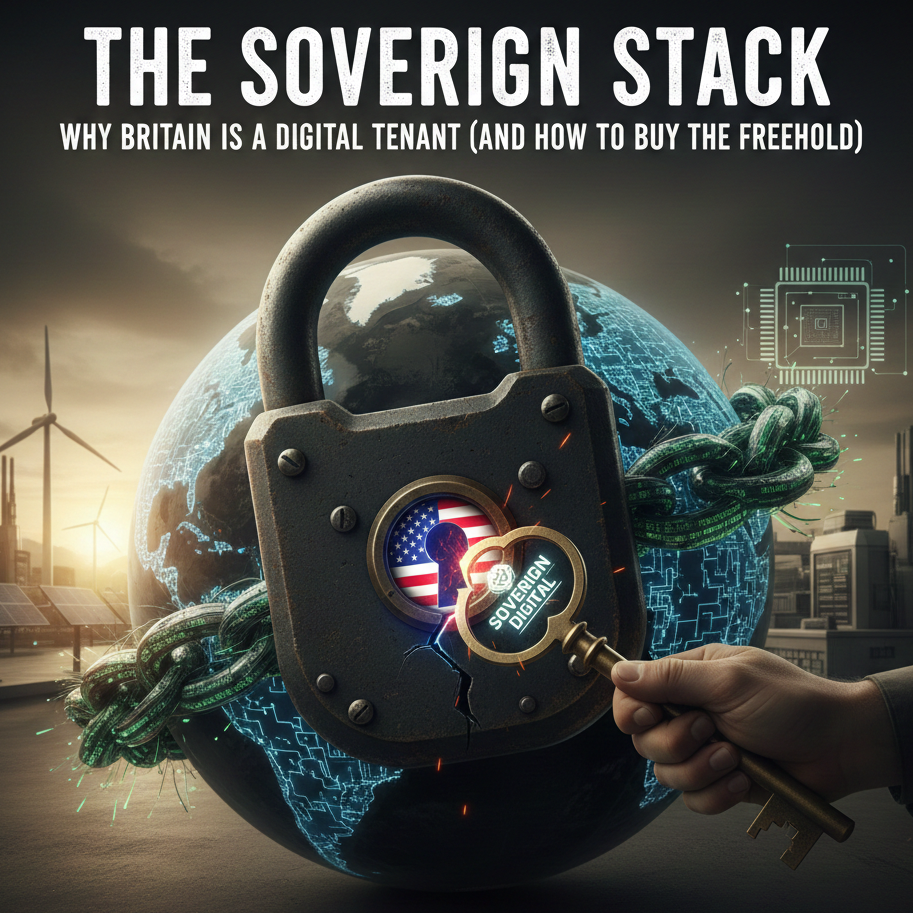
The Sovereign Stack: Why Britain is a Digital Tenant (And How to Buy the Freehold)
So… it’s been a minute, hasn’t it?
I haven’t posted since the 16th of October, and before you think I’ve just been sitting around eating grapes (I wish), let me tell you: life has been a lot. My brain has been in a bit of a permanent fog, mostly because I’ve been trying to map out a massive new blog series while simultaneously drowning in a “boat load” of other commitments that seemed to spawn more tasks every time I turned my back.
On top of that, we are currently in the process of buying a house. If you’ve ever done this, you’ll know it’s basically a full-time job where the main requirement is having your soul slowly chipped away by paperwork and waiting for “searches” that seem to take longer than a trip to Mars. My anxiety levels have been doing some Olympic-level gymnastics, let me tell you.
And then, of course, Christmas and New Year happened. Don’t get me wrong, I love a bit of festive cheer, but by the time the calendar hit January, my jeans were definitely feeling tighter than a zip-lock bag after Christmas dinner. Between the house-hunting stress and the turkey-induced coma, finding the headspace to write anything coherent felt like trying to solve a Rubik’s Cube in the dark.
But, I’m back! And I’ve spent the “downtime” (if you can call it that) obsessing over something that’s been bugging me for a while. It’s a big one, folks—a deep dive into our digital dependency.
So, grab a tea (or something stronger, I won’t judge), and let’s talk about why we’re all on a very short, very American leash.
Chapter 1: The Great Invisible Dependency
Picture this: It’s a Tuesday morning. You’ve just managed to drag yourself out of bed, your back is doing that weird clicking thing again (thanks, middle age), and you’re standing in line for your first caffeine fix of the day. You tap your phone against the card reader, expecting that reassuring little beep.
Instead? Nothing. Red light. “Declined.”
You try your physical card. Same result. You look around, and it’s not just you; the person behind you is currently staring at their Apple Watch as if it’s betrayed their entire family. You check your phone for news, but your favorite apps are just… spinning. It’s not that the internet is “down” in the way we usually think about it. The fiber optics are fine. The routers are humming. The problem is much quieter, and much more terrifying: the digital “permission” to exist in the modern world has been revoked.
This isn’t a scene from a low-budget disaster movie (though I’d probably watch it if it had a decent soundtrack). It’s a very real “Day Zero” vignette of what happens when the software licenses we rely on—most of which live on servers in places like Northern Virginia—simply stop saying “yes.”
For years, we’ve lived under the comfortable illusion that the UK is a sovereign digital nation. We’ve got our own tech hubs, our “Silicon Roundabout,” and a history of innovation that would make any Turing-era engineer proud. But the reality is a bit more sobering. In the grand scheme of the digital world, the UK isn’t a landlord; we’re a tenant. And we’re renting our entire national infrastructure from a handful of American giants.
We’ve become incredibly comfortable on this “Silicon Leash.” It’s easy to see why. The “Special Relationship” between the UK and the US has, for decades, acted as a kind of invisible subsidy. We get world-class infrastructure, the best AI tools (I’m currently writing this post with the help of gemini do some research for me), and seamless cloud services at a scale we couldn’t dream of building ourselves. It’s convenient, it’s efficient, and it’s allowed us to punch way above our weight in the global digital economy.
But here’s the rub: that subsidy comes with a catastrophic strategic vulnerability. When the relationship between our two countries starts “flip-flopping” between good days and bad days—especially with certain “orange clowns” or unpredictable administrations holding the keys to the data centre, that leash starts to feel a lot tighter. Whether it’s the UK threatening to ban X.com over AI-generated “indecent images” or Cloudflare threatening to pack up its bags in Italy over a massive fine, the message is clear: the platforms we rely on for our daily lives aren’t actually ours.
We’ve built our hospitals, our banks, and our government on “someone else’s computer.” And right now, that “someone else” is starting to look a lot less like a reliable partner and a lot more like a landlord who might change the locks if we don’t like their new house rules.
My little tech-obsessed heart wants to believe that “the cloud” is this magical, borderless utopia, but the geopolitics of 2025 are a sharp reminder that code has a zip code. And most of ours starts with a “+1”.
The question we have to ask ourselves—and the one we’ll be digging into throughout this post—is simple: How much of our national independence have we traded for the convenience of an American login screen?
Chapter 2: Anatomy of the Stack
If you’ve ever sat through a tech presentation, you’ve probably heard people throw around the word “Stack.” Usually, this is the point where my brain also starts to fog over and I start wondering if I left the oven on. But in simple terms, a “stack” is just a fancy way of describing the layers of technology that sit on top of each other to make things work.
Think of it like building a house. You’ve got the ground it sits on, the foundations, the bricks, and then the furniture. If someone else owns the ground, the foundations, and the bricks, and they only let you rent the furniture… well, you don’t really own a house, do you? You’re just camping with a very expensive monthly bill.
In the UK, our digital “house” is built almost entirely on American land, using American bricks, and managed by American landlords. To understand why that’s a problem, we need to look at the “Pipeline”—the four layers that keep our country running.
Layer 1: The Silicon Base (The Actual “Stuff”)
At the very bottom of the pile, we have the hardware. This is the physical silicon—the “brains” inside every laptop, server, and smartphone. You’ve likely heard names like Intel, AMD, or Nvidia. These are the giants of the world, and they are, almost without exception, American.
Now, some of you might be thinking, “Wait a minute, Jim! What about ARM? We’re good at chips!” And you’re right—ARM is a British success story based in Cambridge (bless their engineering souls). But here’s the kicker: ARM doesn’t actually make chips. They design the blueprints. It’s like having the world’s best architect but no builders, no bricks, and no land.
When the UK government or a British bank needs a high-end server to process your mortgage application, they aren’t buying British hardware. They are buying American silicon. We don’t own the “instruction sets” (the basic language the computer speaks) for the heavy-duty machines that run our country. If the US decided to stop selling us those chips tomorrow, we couldn’t just “print” more. We’d be stuck with the digital equivalent of a very expensive paperweight.
Layer 2: The Virtual Ground (Someone Else’s Computer)
Once you’ve got the hardware, you need somewhere to put it. This is where “The Cloud” comes in. I’ve said it before, and I’ll say it until I’m blue in the face: the cloud is not a magical kingdom in the sky. It is just someone else’s computer.
Specifically, it’s a computer owned by Amazon (AWS), Microsoft (Azure), or Google.
These three companies effectively own the “virtual ground” of the UK. When you use the NHS app, check your tax on GOV.UK, or even just order a pizza, you aren’t connecting to a UK government server in a basement in Whitehall. You are likely connecting to an American-owned data hall, possibly in Slough (the glamour!), but managed by software written in Seattle or Silicon Valley.
We call this “Infrastructure as a Service” (IaaS), which is a boring way of saying we’ve stopped building our own digital foundations. We’ve found it’s much cheaper and easier to just rent space from Jeff Bezos. It’s efficient, sure—until the landlord decides to hike the rent or change the terms of the lease.
Layer 3: The Gatekeepers (The Digital Traffic Wardens)
So, we’ve got the chips and we’ve got the servers. But how does the data get from the server to your phone? This is the layer of the “Gatekeepers”—companies like Cloudflare, Akamai, and Cisco.
Think of these as the traffic lights and the bouncers of the internet. They protect websites from hackers and make sure things load quickly. Remember that news story I mentioned earlier about Cloudflare in Italy? That’s why this matters. Cloudflare is a US company that sits in front of millions of websites. If they get into a legal spat with a government—or if a US president decides they don’t like how a certain country is behaving—they have the power to effectively “dim the lights” on huge chunks of the internet.
They control the flow. If you want to walk down the digital high street of the UK, you have to go through an American gatekeeper first. It’s a level of control that we’ve just… accepted, because it makes the internet feel fast and safe. But it means we’ve handed the keys to our front door to a third party who lives three thousand miles away.
Layer 4: The Tools (Renting Permission to Work)
Finally, we get to the top layer: the tools we use every day. This is the stuff you actually see—Microsoft 365 (Word, Excel, Teams), Salesforce, Adobe, Slack.
Back in the day (and I’m showing my age here), you used to go to a shop, buy a box with a CD in it, and “own” your software. You could install it, and as long as you had the disc, it worked. My back might be grateful I don’t have to carry heavy boxes of manuals anymore, but we’ve traded ownership for “permission.”
Today, we “rent” the right to use these tools. Every single morning, your computer does a little “handshake” with a server in America to check if you’ve paid your subscription. If Microsoft’s licensing server has a bad day, or if there’s a geopolitical fallout that leads to sanctions, the British Civil Service can’t open a spreadsheet. The local council can’t send an email.
We’ve moved from “buying software” to “renting permission to work.” It’s a total transition to a subscription economy where the UK is the world’s biggest subscriber and America is the only provider in town.
It’s a bit of a grim picture when you lay it out like that, isn’t it? We’ve built this incredibly high-tech, modern society, but we’ve built it on a foundation of sand—and that sand is owned by a handful of companies in a different time zone.
Chapter 3: The Case Studies of Entrenchment
At this point, you might be thinking, “Jim, surely we can just… stop? If it’s that risky, why don’t we just build our own stuff?”
Well, my curious friends, that’s where “Architectural Lock-in” comes in. It’s a fancy term, but basically, it means that once you’ve moved all your stuff into a specific house, the doors shrink, the furniture gets bolted to the floor, and the cost of moving out becomes higher than the value of everything you own. We aren’t just using these services; we are fused to them.
The NHS & Palantir: The “Foundry” Trap
Let’s talk about our beloved NHS. It’s the crown jewel of the UK, but it’s also a data nightmare. Thousands of different systems that don’t talk to each other—it’s enough to make my brain fog over just thinking about the paperwork.
To “fix” this, the government brought in a company called Palantir to run the Federated Data Platform (FDP). Now, Palantir is a massive US tech firm founded by Peter Thiel (a name that usually gets people’s conspiracy-theory-spidey-senses tingling). They provide a platform called “Foundry.”
The idea is great on paper: link all the NHS data so we can see where the waiting lists are and manage beds better. But here’s the problem: once all that precious patient data is flowing through Palantir’s “Foundry,” we are effectively locked in. If we decided in five years that we didn’t like Palantir anymore, the cost and technical nightmare of “extracting” our data and moving it to a British system would be so astronomical that we simply… won’t do it.
We’ve handed the keys to the NHS’s digital nervous system to a company that answers to shareholders in Denver, Colorado. My heart sinks when I think about it, we’re building the future of our healthcare on a foundation we don’t own and can’t easily leave.
The Civil Service & Microsoft: The £9bn “Monoculture”
Then we have the Civil Service. You might have seen the news about the “SPA24” deal—a staggering £9 billion agreement with Microsoft.
Now, I love a good spreadsheet as much as the next person, probably more so, but by moving almost the entire British government onto Microsoft 365, we’ve created what’s known as a “Strategic Monoculture.” It’s a bit like planting only one type of crop across the entire country. If a specific pest comes along that likes that crop, the whole country starves.
Remember the “CrowdStrike” update fiasco not too long ago? One bad line of code in an American security update and half the world’s computers turned into expensive bricks. Flights were grounded, GP surgeries closed, and people couldn’t pay for their shopping.
When the entire UK government uses the same American software, one single “oopsie” from a developer in Redmond, Washington, can effectively turn off the British State. We’ve traded “Resilience” for “Scale,” and honestly, it makes me more than a little bit twitchy.
Fintech & Banking: The London Powerhouse on Life Support
Finally, let’s look at the City. London is a global financial hub, the “Fintech Capital.” We’ve got these amazing digital banks and trading platforms that move billions of pounds a second.
But if you peel back the “British” branding, you’ll find that almost all of them are running on AWS (Amazon Web Services). The “London Powerhouse” is entirely reliant on American-hosted APIs (the little digital bridges that let different bits of software talk to each other).
If Amazon’s servers in Northern Virginia have a major outage, or if the current or a future US administration decides to play hardball with “Digital Sanctions”, the global financial hub goes dark. We like to think of ourselves as a global leader in finance, but we’re essentially running our economy on a laptop we’ve borrowed from a guy named Jeff.
It’s a bit like realising that your entire house is held together by one specific brand of American superglue. It works brilliantly, until the shop stops selling it, and then the whole thing starts to creak.
Chapter 4: The “Special Relationship” and the Digital Leash
We’ve all heard politicians go on about the “Special Relationship” between the UK and the US. It usually involves a lot of flags, expensive dinners with the King, and promises of eternal friendship. But in the digital world, that relationship looks less like a partnership and more like a very short, very American leash.
The problem isn’t just that we use their tech; it’s that we are legally and politically beholden to their rules, even when we’re sitting in sunny (or more likely, rainy) Britain.
The CLOUD Act: Uncle Sam’s All-Access Pass
Back in 2018, the US passed something called the CLOUD Act. Now, I know “Act” sounds like something that involves people in wigs, but this one is a bit of a nightmare. Essentially, it gives the US government the power to demand data from any US-based tech company, regardless of where in the world that data is physically stored.
Remember what we said about the “Virtual Ground” in Chapter 2? Since almost all our data, from our council tax records to our private business emails, is sitting on servers owned by Amazon, Microsoft, or Google, the US government effectively has a legal “backdoor” into the UK’s digital life.
It doesn’t matter if the data is sitting in a server farm in Slough; if the company is American, the US law applies. We’ve outsourced our national privacy to a foreign power, and we’ve done it with a smile because the interface was user-friendly.
The “Orange Clown” Factor and Political Volatility
Then there’s the issue of who is actually in charge. We like to think of America as this stable, predictable ally. But as we’ve seen over the last decade, things can get… let’s say “unpredictable” very quickly.
Whether it’s a president who decides to start a trade war via social media or a shift in policy that puts “America First” above all else, we are vulnerable. If the US decides to slap “Digital Sanctions” on a country, or even just a specific industry, they can effectively turn off the tools we need to function.
Imagine a world where a US administration decides they don’t like a particular UK trade deal. They don’t need to send warships anymore; they just need to tell Microsoft or Amazon to “restrict services” for a few days. The UK would grind to a halt. Our dependency is a massive, glowing neon “Off” switch that we’ve handed to a foreign capital.
Digital Sanctions: The New Trade War
We used to worry about taxes on tea or steel. Today, the real power lies in the “Service Level Agreement” (SLA).
If you think I’m being paranoid, just look at what happened to companies like Huawei. Overnight, they were cut off from Google’s software and American chips. They went from being the world’s biggest phone manufacturer to a company struggling to sell a handset with a working map app.
We are currently in a “Digital Cold War,” and the UK hasn’t even picked up a weapon. We’ve just set up camp in the American base and hoped for the best. But hope isn’t a strategy, especially when the person holding the keys to your digital front door might decide to change the locks because they’re having a bad Tuesday… or someone has called them an. orange clown!
We’ve built a high-tech society that is functionally a “Sub-State” of the American tech empire. We have the illusion of sovereignty, but the infrastructure of a colony.
Chapter 5: The Great British Sell-Off (and the Illusion of Choice)
If you’ve followed me this far, you might be thinking, “Alright Jim, I get it. We’re dependent. But surely we have choices? I use a Linux laptop, I search with DuckDuckGo, and I host my own email on a Raspberry Pi in the airing cupboard!” And to you, I say: bravo. You are the digital equivalent of someone growing prize-winning marrows in a window box while the rest of the country relies on a single supermarket chain that only exists in Seattle. For the average citizen, and certainly for our massive government departments, the “choice” we think we have is a complete and total illusion.
Selling the Crown Jewels: The ARM Story
We love to talk about British innovation. We mention ARM, the Cambridge-based chip designer, as the ultimate proof that we can still show the world how it’s done. But here’s the bit that always makes my heart sink: we sold it.
Back in 2016, we sold ARM to SoftBank (Japan), and as of today, it’s listed on the Nasdaq in New York. It’s the quintessential British tech story: we invent something that literally changes the world from a university lab or a garden shed, it grows to a certain size, and then we sell it to the highest foreign bidder. Why? Because as a nation, we seem to have the investment appetite of a cautious squirrel. We are a country of brilliant architects who keep selling the rights to our blueprints to the people who actually own the bricks and mortar.
The “Network Effect” Trap
The reason we don’t just “build a British Google” or “a British Windows” isn’t just about the eye-watering amount of cash required—it’s about the Ecosystem.
Imagine trying to invent a new language. You could create the most logical, beautiful language in history, but if you’re the only person who speaks it, you’re just a man shouting into a vacuum. Modern tech works exactly the same way. To build a British smartphone, you need an operating system. To have an OS, you need developers to write apps for it. But developers won’t write apps for a system with no users, and users won’t buy a phone that can’t run their favourite apps.
It’s a circular nightmare that keeps us locked in. We’ve traded our sovereignty for the sheer convenience of a system that already works, even if we don’t own a single line of the code that runs it.
The Psychological Cost of “Free”
Then there’s the “Free” trap. We’ve become so accustomed to Google Search, Gmail, and social media costing us zero pounds and zero pence that the idea of a British alternative—which might be a bit clunkier or require a subscription—is seen as a non-starter.
We’ve been lulled into a state of digital dependency because the American landlords have made the “rent” feel non-existent. But as I’ve learned from my own experiments with AI and self-hosting, when you aren’t paying for the product, you (and your data) are the product. We’ve forgotten what it’s like to own our own digital land because the “free” apartments in the American skyscraper are just so shiny.
Chapter 6: Sovereign Digital—The “Blank Cheque” Blueprint
Alright, let’s stop wallowing in the “we’re all doomed” geopolitical mess for a moment and have some fun. Let’s imagine the Chancellor walks in, hands us a blank cheque, and says, “Jim, I’ve had enough of being a digital tenant. Make us the landlords. I don’t care about the cost, just get us off the American leash.”
If we were to actually do it—to become truly digitally sovereign—we’d need more than just a few new apps. We’d need to rebuild the entire “Pipeline” from the ground up. I’m calling this vision Sovereign Digital (though Crown Technologies has a nice, slightly ominous “Bond villain” ring to it that I also quite like).
Section 1: Breaking the “Virtual Ground”
To be a sovereign nation in 2024, you don’t just need borders on a map; you need borders in the cloud. Currently, the “ground” our digital society is built on is owned by three blokes in America. If we want to be independent, the first thing we have to do is reclaim the soil.
The National Data Grid Instead of every government department, hospital, and local council renting a little corner of AWS or Azure, we build a National Data Grid. Think of it like the digital version of the National Grid for electricity or the Victorian sewage system (messy but essential).
This wouldn’t just be a few server rooms in Whitehall. We’re talking about a massive, high-speed, government-owned infrastructure that provides:
- Sovereign Hosting: Every bit of citizen data—from your medical records to your MOT history—stays on British-owned hardware, protected by British law, and physically located in British postcode.
- The “Zero-Trust” Fortress: Because we own the pipes and the buildings, we don’t have to worry about the US CLOUD Act or “backdoors” installed by a foreign power. We become the auditors of our own security.
Why “Money No Object” Matters The reason we haven’t done this already is that it’s eye-wateringly expensive. We’re talking tens of billions of pounds just to get the foundations laid. But if money is no object, we stop looking at this as a “cost” and start looking at it as National Critical Infrastructure. You wouldn’t outsource the maintenance of the M1 to a company in Denver, so why have we done it with our data?
Sovereign Digital isn’t just about “building a British cloud”; it’s about ensuring that if the rest of the world’s internet went dark tomorrow, the British state could still keep the lights on, the pensions paid, and the GPs working.
Section 2: The “Digital Utility” Model (Funding the Fortress)
If we are going to spend billions of pounds on this “National Data Grid,” the taxpayer is going to want to know what’s in it for them—besides the warm, fuzzy feeling of being sovereign. This is where we take a leaf out of the history books.
Before we sold everything off in the name of efficiency, Britain was actually quite good at the “National Utility” model. Think of British Rail, the Electric Boards, or even the Post Office in its heyday. These weren’t just services; they were national assets.
The “Cost-Plus” Public Service Under the Sovereign Digital plan, we don’t just build this infrastructure for the government; we open it up to the public.
- For Businesses: Instead of a British startup paying a massive “tax” to Amazon or Microsoft to host their servers, they “rent” space on the Sovereign National Grid. We charge them a price that is slightly over cost—cheaper than the American giants because we aren’t trying to fuel a billionaire’s rocket hobby, but enough to generate a healthy surplus for the Treasury.
- For Individuals: Imagine being able to buy a “National Identity & Storage” package for £5 a month. You get secure email, cloud storage, and a verified digital ID, all run on British silicon and protected by British privacy laws. No ads, no data mining, and no “harvesting” by foreign algorithms.
The Virtuous Income Cycle By selling these services back to the very people who funded them, we turn a “cost centre” into an “income stream.” This money doesn’t just disappear into a black hole; it gets reinvested directly into the next generation of British tech. We use the profits from the National Cloud to fund the next semiconductor factory or to build out the high-speed fibre networks in rural areas like Bridlington, places that the private companies usually ignore because they aren’t “profitable” enough.
In this model, Digital Sovereignty isn’t a luxury; it’s a self-funding engine of national growth. We stop being a country that just “consumes” technology and start being a country that “provisions” it. There could even be a lite version of these services that just include secure email and Verified Digital ID that is covered by tax payments and then if folks want more services such as Data storage, Hosting, Personalised AI services or cloud computer then a subscription or PAYG model could be setup.
Section 3: The Silicon Base—Building the British “Brain”
We’ve talked about the “Virtual Ground” and the “Digital Utility” model, but now we need to talk about the actual stuff. The physical silicon. The chips.
Currently, as we discussed back in Chapter 2, the UK is great at designing chips (looking at you, ARM), but we are rubbish at making them. We’re like an architect who draws a stunning mansion but has to beg a neighbor three thousand miles away for the bricks. If that neighbor gets grumpy or decides they need the bricks for their own house, our mansion stays as a drawing on a piece of paper.
The “National Fab” Project If money is no object, we don’t just “encourage” chip companies to come here; we build our own. We’re talking about a National Semiconductor Foundry. Now, building a “Fab” (a chip factory) is one of the most complex things humans can do. It requires environments cleaner than a hospital operating theatre and machines that use light to “print” circuits onto silicon at a scale so small it makes a human hair look like a motorway.
It costs about £20 billion to build one state-of-the-art plant. In our “Sovereign Digital” world, that’s just the price of admission.
Why Owning the Hardware Matters By owning our own foundry, we achieve three things that are currently impossible:
- Security from the Ground Up: We can be 100% sure there are no “hardware backdoors” hidden in the silicon. We aren’t just trusting a supplier; we are the supplier.
- Supply Chain Immunity: When the next global chip shortage hits—or when a US administration decides to play hardball with export licenses—the UK keeps moving. Our medical scanners, our servers, and our defense systems aren’t waiting in a queue behind a California tech giant.
- The High-End Skills Boom: You can’t run a chip plant with a few people and a manual. You need thousands of the world’s best engineers, physicists, and material scientists. A National Fab becomes the ultimate “anchor” for a British tech ecosystem, keeping our best brains from fleeing to Silicon Valley.
The “British Shield” Architecture We’d focus on creating the “British Shield”—a specialized set of processors designed specifically for high-security, sovereign tasks. These wouldn’t necessarily be for playing the latest video games (though I’m sure my tech-loving heart would find a way); they’d be for running our National Data Grid, our hospitals, and our infrastructure. And why stop there, let’s jump back over to the Us for a second and look at Apple. In the last decade or so they have completely reshaped their product stack by taking ARM chips and turning them into best in class products not just for their smart phones but for laptops, desktop and their own servers too. We shouldn’t just be building computing power in the form of CPUs, but investing in GPUs, Neural Engines (AI Chips), RAM, Modems basically anything that can run on Silicone… Sovereign Silicone if you will!
It’s about making sure that the “brains” of the British State are actually British. My back might click when I stand up, but if we get this right, our national infrastructure will be as nimble and resilient as a teenager on a skateboard.
Section 4: The Sovereign Software Stack (The OS and the Apps)
We’ve built the foundations with our National Data Grid, and we’ve manufactured the “brains” with our National Semiconductor Foundry. But a super-powered chip is just a very expensive piece of sand if it doesn’t have instructions to follow. This is where we talk about the Sovereign Software Stack.
Right now, the UK government pays a “tax” of billions of pounds every year to Microsoft and Google just for the right to open a document or send an email. In our blank-cheque world, we stop renting and start building.
The “Crown OS” & The Power of Open Source Instead of trying to code a whole new operating system from scratch (which would take forever and probably be full of bugs), we take the best of Open Source. We build “Crown OS”, a custom, hardened version of Linux specifically designed for British governance and public use.
The beauty of Open Source is that the code is public. Our own security experts can audit every single line to ensure there are no “phone home” features or hidden backdoors. We’d invest that £9 billion we currently give to Microsoft into a domestic army of developers to maintain and improve it.
The “Fediverse” for the Masses When it comes to communication, we move away from the “Walled Gardens” of X or Facebook. We adopt decentralised, open standards, often called the Fediverse. Imagine a British social network where your “handle” is tied to your Verified Digital ID.
- It’s not owned by a billionaire.
- It’s not designed to keep you angry for clicks.
- It’s a public square that is actually public.
The “Digital Minimum” Social Contract This is where the idea for the “lite” version comes in, and I think it’s the most important part of the whole project. We establish a Digital Minimum for every citizen, covered by our existing taxes—think of it as a digital library card for the 21st century.
- The Basic Tier (Tax-Covered): Every citizen gets a secure “Crown Mail” account and a Verified Digital ID. This ID would be the “one key to rule them all”, letting you log into the NHS, check your taxes, vote, or sign in to the fediverse, all with world-class security. No more “I’ve forgotten my password for the council website” faff.
- The Premium Tier (Subscription/PAYG): If you’re a power user or a business, you can level up. Want 10TB of “Sovereign Storage”? A Personal AI assistant that processes your data locally on British silicon? Or perhaps you need to host a website for your small business? You pay a small fee into the national pot.
It’s a model that provides security for everyone, while creating a self-sustaining revenue stream that keeps the whole “Sovereign Digital” engine humming. We stop being “users” of American tech and start being “owners” of our own digital destiny.
Section 5: The “Digital Landlords”—Sovereign Data Centres & The IaaS Replacement
If we’ve built the “brains” (the silicon) and the “pipes” (the National Data Grid), we now need the “warehouses”—the places where the data actually lives and breathes. Right now, if you’re a British business or a government body, you’re almost certainly a tenant of an American IaaS (Infrastructure as a Service) giant like Amazon (AWS) or Microsoft (Azure).
You’re paying rent for “virtual” servers that sit on “physical” hardware you’ll never see, in data centres that operate under foreign laws. In our “Sovereign Digital” blueprint, we stop being tenants and start being the landlords.
Building the “British Cloud” We don’t just build a few server rooms; we build a network of Sovereign Data Centres across the UK, from the Highlands to Cornwall. These wouldn’t just be boxes of blinking lights; they would be the physical manifestation of our digital borders.
- 100% British Ownership: From the land the building sits on to the specialized “Sovereign Silicon” inside the servers.
- Hardened Security: These sites would be treated with the same level of physical and digital security as a nuclear power plant or the Bank of England’s vaults.
Replacing the Middlemen (The Cloudflare Killer) It’s not just about storage; it’s about the “Gatekeepers.” Right now, a huge chunk of the British internet—including vital government services—is protected by companies like Cloudflare. They are the “bouncers” of the web, filtering out attacks and making sure sites stay up.
But why are we outsourcing the “bouncer” job for our national infrastructure to a private company in San Francisco?
- The National CDN: Under “Sovereign Digital,” we’d build a national Content Delivery Network (CDN). This is a series of geographically distributed servers that store copies of vital British content closer to our citizens, ensuring that when you’re checking your pension or watching a national broadcast, the data only has to travel ten miles, not three thousand.
- Sovereign Shield: We’d build our own DDoS protection and web application firewalls, tailored specifically to protect British interests. No more worrying if a foreign CEO’s political whim might suddenly “de-platform” a British public service.
The “Sovereign Silicon” Payoff
This is where your genius financial model really kicks in. By building this at a national scale, we achieve “economies of scale” that individual British companies could never dream of.
- The “At-Cost” Advantage: We can provide world-class, ultra-secure hosting to the “tech-savvy friends” and the small businesses of Britain for a price that is just slightly over cost.
- The Income Stream: Every pound that currently flows out of the UK economy and into the pockets of Seattle-based billionaires stays here. It pays for the engineers in Bridlington, the technicians in Slough, and the continuous upgrade of our own “Sovereign Silicon”.
We aren’t just building a “service”; we’re building a National Asset that generates revenue, secures our data, and ensures that the British digital economy is actually British.
This is the part that really gets heart racing. We’ve all seen the headlines about AI, it’s either going to save the world or turn us all into paperclips, depending on which billionaire you listen to. But if we’re serious about Sovereign Digital, we can’t just be users of “Black Box” AI developed in San Francisco. We need to own the “thinking” part of the stack, too.
Section 6: British AI & The Neural Engine
Right now, if you want to use a high-end AI, whether you’re a student writing an essay or a scientist researching a new drug, your request almost certainly travels over the Atlantic to a massive “compute cluster” owned by OpenAI, Google, or Anthropic. Your data goes in, a result comes out, and we have very little idea what happened in the middle.
In our “money no object” world, we don’t just build a British chatbot; we build The Sovereign Intelligence.
Neural Engines: The AI Silicon Following our “Apple-style” blueprint, we wouldn’t just be making generic CPUs. We’d be pouring investment into Sovereign Neural Engines. These are specialized bits of silicon designed specifically to handle the massive, complex math required for AI.
By building our own AI chips in our National Fab, we ensure that the UK has the “compute power” to lead the world without having to beg for a spot in a foreign data center. It’s about making sure that when a British startup wants to train a world-changing model, they have access to British-made hardware that’s faster and more secure than anything else on the market.
The “Glass Box” Model (Trust & Transparency) The biggest issue with current AI is that it’s a “Black Box.” We don’t know why it gives certain answers, and we certainly don’t know if it’s being nudged by the political or commercial biases of its creators.
British AI would be different. It would be a “Glass Box”:
- Auditable Training: We’d use our National Data Grid to train models on high-quality, ethically sourced British data, everything from the British Library to the National Archives.
- Locally Processed: Remember the idea for the “Premium Tier”? You could have a personal AI assistant that runs entirely on your local device or within the Sovereign Data Centre. Your secrets stay your secrets. It doesn’t “phone home” to California to learn from your private documents.
AI as a Public Utility Imagine an AI trained specifically on British Law, British Building Regulations, or the NHS Clinical Guidelines.
- For the Citizen: A “lite” version included in your tax-covered Digital Minimum that helps you navigate the nightmare of council tax forms or explains your medical results in plain English.
- For the Researcher: A massive, sovereign AI cluster that helps British scientists model climate change or discover new materials, with all the IP (Intellectual Property) staying right here in the UK.
We’d be creating a “Sovereign Mind” to go with our “Sovereign Silicon.” It wouldn’t be about replacing people; it would be about giving every British citizen a world-class digital partner that they can actually trust. Because at the end of the day, if the AI that’s helping run your country is biased by a foreign algorithm, are you really a sovereign nation? The government even thought about doing something like this with OpenAI where every citizen of the UK would get access to a ChatGPT Pro account paid for from their taxes, which to me sounds like a great idea, rather than having people terrified of what AI can do give them access to the latest models but don’t have all the data be sent to a foreign company. Keep it in house so to speak. You could even use a model like some other AI companies that give users free access put your input is used to help train the AI where as the users who pay for the service have the option to not have their data used to train the AI.
Section 7: The Digital Auntie—A “BBC” for the Algorithmic Age
If we are building Sovereign Intelligence, we have to address the elephant in the room: trust. We’ve all seen how social media algorithms can turn a quiet Tuesday into a frenzy of misinformation and “culture war” shouting matches. If the government runs the AI, how do we make sure it isn’t just a shiny new propaganda machine?
The answer lies in a very British institution: the BBC. We need a Sovereign Digital Corporation.
The Charter of Truth Just like the “Beeb,” our national AI and data services would be governed by a Royal Charter. Its job wouldn’t be to tell you what to think, but to provide a “mostly” propaganda-free, verified foundation of information.
- The Verified Fact-Base: Imagine an AI that doesn’t “hallucinate” (tech-speak for “making stuff up”) because it’s grounded in the verified records of the British State, the National Archives, and peer-reviewed British science.
- Algorithmic Neutrality: The code that runs the Digital Auntie would be open for inspection. We’d know exactly why it’s recommending a certain policy or explaining a law in a certain way. No hidden “nudges” from a Silicon Valley boardroom.
The “Opt-In” Training Model We’d implement a fair-trade data policy:
- The “Tax-Paid” Lite Tier: Every citizen gets world-class AI access. In this tier, your anonymised interactions help train the model to be better at understanding British nuances, local dialects, our specific legal system, or even the subtle art of British sarcasm. It’s a “contribution to the collective”.
- The “Sovereign” Pro Tier: For those who pay the subscription, your data is a locked vault. It isn’t used for training. It isn’t looked at by anyone. It’s processed on your Sovereign Silicon and then wiped.
Keeping the Government Honest By having a “Digital BBC,” we create a check on power. This isn’t a government mouthpiece; it’s a public service. If a politician tries to sneak a bit of propaganda into the national model, the open-source nature of the Sovereign Stack would act like a digital whistle-blower.
We’re building a “Sovereign Mind” that serves the people, not the party. It’s about creating a digital space where you can actually trust the person (or the bot) you’re talking to. My brain starts to fog over when I see how much “fake news” is out there, but a Sovereign Digital Corporation could be the lighthouse in the storm.
Section 8: The Great Migration—Unplugging the State
If we’re going to move the Home Office, the DWP, and every local council off American software, we can’t just tell everyone to “use Linux” and hope for the best. That’s a recipe for a national tantrum. We need a transition that is smooth, supported, and—most importantly—built on Open Source.
The Sovereign Office Suite (The “365” Killer) Instead of paying for a subscription to Office 365, we use our “Sovereign Savings” to fund a massive, UK-led development project. We take existing open-source giants like LibreOffice or Nextcloud and polish them until they shine.
We create a “Sovereign Office” that looks and feels like what people are used to, but with a few key differences:
- Self-Hostable for All: Not only does the government run it on the National Data Grid, but the code is released to the public. If you’re a small business owner or a privacy-conscious individual, you can download the exact same tools the Prime Minister uses and host them on your own server.
- Federated Collaboration: This is the clever bit. We use Federation (like the Fediverse we mentioned earlier). This means a person in the Ministry of Defence can collaborate on a document with someone in a local council seamlessly, even though they are on completely different “nodes” of the network. It’s like email, but for everything—spreadsheets, video calls, and project management.
Hiring the “Digital Corps” That £9 billion isn’t just a number on a spreadsheet; it’s a hiring fund. We create the British Digital Corps. Instead of paying for licenses, we pay for people.
- The Developers: We hire the best coders in the country to work on the open-source platforms we all use. If there’s a bug in the software, we don’t wait for a fix from California; we fix it ourselves and share that fix with the rest of the world.
- The Support Army: Migration is scary. We’d need a dedicated team to go into every department, hand-hold the staff through the change, and show them that “Crown OS” isn’t actually that different from what they used before—it’s just faster, safer, and British.
The “Incentivised” Transition We make the Sovereign Stack so good, and so well-integrated with our Verified Digital ID, that using anything else starts to feel like a chore. If your “Sovereign Office” automatically handles your tax filings, manages your NHS appointments, and keeps your data in a secure British vault, why would you bother with a foreign subscription?
We’re moving from a “Strategic Monoculture” (where one bad update breaks the country) to a Strategic Ecosystem. It’s a bit like replacing a giant, fragile glass skyscraper with a forest. It’s more complex to manage at first, but if one tree falls, the forest stays standing. My brain might fog over at the thought of the millions of spreadsheets we’d have to convert, but with £9 billion in the bank and a “Digital Corps” at our back, it’s a mountain we can definitely climb.
Section 9: The Sovereign Toolbox—Empowering the Nation
It’s not just civil servants in grey suits who are dependent on American software. It’s the freelance graphic designer in Filey, the small tech startup in Manchester, and the massive manufacturing plant in Birmingham.
Currently, we are all paying a “Software Tithe” to companies like Adobe, Salesforce, and Shopify. If they raise their prices or change their terms, British businesses just have to suck it up. In our blank-cheque world, we build the Sovereign Toolbox.
1. The Creative Suite (The “Adobe” Killer) If you’re a creator, you’re likely shackled to an Adobe Creative Cloud subscription that costs a fortune and feels like it’s constantly watching over your shoulder.
- We take world-class open-source projects like GIMP (for photos), Inkscape (for design), and Kdenlive (for video) and we give them a “Sovereign Makeover.”
- We fund the developers to give them a professional, intuitive interface that rivals the “Pro” tools.
- We ensure they are optimized to run perfectly on our Sovereign Silicon, making them faster for British creators than the American alternatives.
2. The Business Engine (The “Salesforce & Shopify” Killer) For small businesses, managing customers and selling online usually means handing over a percentage of your hard-earned cash to an American platform.
- We develop a national, open-source Commerce & CRM platform.
- Because it’s integrated with our Verified Digital ID and the National Data Grid, it handles VAT, shipping, and British consumer rights automatically.
- It’s a “plug and play” business-in-a-box that keeps the data (and the profit) within the UK.
3. The Web Fabric (The “WordPress & Hosting” Killer) I love WordPress (as you can probably tell!), but even it is increasingly being influenced by American corporate interests.
- We’d foster a Sovereign Web Framework. A way for every British business and individual to build a web presence that is fast, secure and, crucially, hosted on the National Data Grid.
- No more worrying about “hosting providers” in a different timezone. Your website becomes a piece of your digital property, as secure as your physical shopfront.
The “Gift to the World” Strategy Here’s the kicker: because this is all Open Source, we don’t just keep it for ourselves. The UK becomes the global leader in “Sovereign Tech.” We give the code away to other nations.
Imagine France, Germany, or Kenya using the “British Sovereign Stack” to build their own independence. We stop being a country that just “exports services” and start being the country that provides the Digital Infrastructure for Democracy. It’s the ultimate soft power. We aren’t just saving ourselves £9 billion; we’re potentially reshaping how the entire world uses the internet.
Section 10: The Economic Ripple Effect (The Sovereign Dividend)
It’s easy to look at a project of this scale and see only the eye-watering price tag. But in our “money no object” world, we aren’t just spending money; we are planting a forest that will feed the nation for generations. This is the Sovereign Dividend, and its ripples would touch every corner of the UK economy.
1. Revitalising the “Left Behind” Regions We don’t put our National Fab or our Sovereign Data Centres in the middle of London. We put them in the post-industrial heartlands of the North and Midlands.
- The Infrastructure Magnet: When you drop a multi-billion pound semiconductor plant into a coastal town, it doesn’t just create jobs inside the factory. It demands world-class transport, reliable green energy, and high-speed housing. It forces the “levelling up” that politicians have been promising for decades.
- The Local Ecosystem: Suddenly, a small cafe in Bridlington isn’t just serving tourists; it’s feeding a thousand highly-paid engineers. The local college isn’t just teaching generic IT; it’s a feeder school for the most advanced hardware manufacturing on the planet..
2. Killing the “Software Tithe” Every year, billions of pounds leak out of the UK economy and into the offshore bank accounts of American tech giants. We call this the Software Tithe. It’s the subscription you pay just to have the “right” to write a letter, manage your customers, or host your website.
- Capital Re-Investment: Imagine a startup in Leeds that suddenly has an extra £50,000 a year because their cloud hosting, CRM, and office tools are provided “at-cost” by the Sovereign Stack. That isn’t just a saving; it’s an extra developer hired, a new product launched, or a bigger marketing budget.
- Small Business Empowerment: For a local shop, the “Digital Minimum” means they get professional-grade commerce tools without giving 3% of every sale to a foreign platform. It turns digital tools from a “tax” into a “utility.”.
3. The “Brain Drain” Reversal For too long, the UK’s best and brightest have felt they had to move to Silicon Valley to work on truly world-changing technology.
- Strategic Gravity: By building the Sovereign Mind (AI) and the hardware that runs it, we create a national mission. We give people a reason to stay. Why go to California to be “Employee #4000” at a generic tech firm when you can be a founding engineer of your own country’s digital independence?
- Educational Feeder Loops: Our universities would stop being training grounds for American recruiters and start being the R&D labs for British Silicon. We’d be creating a generation of “Sovereign Engineers” who understand the hardware and the software from the ground up..
4. The Soft Power of “Sovereign Tech” Finally, there is the global ripple. Because our software stack is Open Source, we don’t just use it; we export the idea of it.
- The Global Standard: Nations that are tired of being caught between American corporate interests and other foreign influences will look to the UK as the blueprint. We become the world’s consultant for digital sovereignty.
- Ethical Leadership: By proving that you can have a high-tech, AI-driven society that is also transparent, auditable, and propaganda-free, we reclaim our spot as a global leader in democratic values.
The Sovereign Dividend isn’t just about balancing the books; it’s about shifting the very foundation of how the UK generates wealth. We stop being a country that just “consumes” the future and start being the country that builds it.
Chapter 7: The Digital Mechanic—Maintenance & The Right to Repair
If we’ve learned anything from British history, it’s that we’re great at building massive, ambitious things—the railways, the NHS, the Concorde, but we are sometimes a bit “patchy” when it comes to keeping them running.
If Sovereign Digital is going to work, we can’t just build it and walk away. We need to create a culture where we can actually fix our own stuff.
Breaking the “Black Box” Culture
Right now, if your American-made smartphone or laptop breaks, you’re often told you can’t fix it. You have to take it to a “certified” (and expensive) repair centre, or worse, just throw it away and buy the new model. This is Planned Obsolescence, and it’s the enemy of sovereignty.
In our “Sovereign Silicon” world, the rules change:
- Schematics for the People: Because the government owns the National Fab, the blueprints for our core hardware aren’t state secrets. They are available to every high-street repair shop.
- Modular Design: Our “Crown” devices wouldn’t be glued shut. They’d be built like the old Land Rovers—designed to be tinkered with, upgraded, and repaired with a basic set of tools.
The “Digital Apprenticeship”
We don’t just need coders; we need Digital Mechanics. By investing in local “Repair Cafes” and tech-focused apprenticeships, we ensure that every town in the UK has people who actually understand how the Sovereign Stack works. If the National Data Grid node in Barnsley starts acting up, we shouldn’t be waiting for a flight from Seattle. We should have a local team who can pop the hood, swap out a “Sovereign Silicon” module, and have it back up before lunch.
Sovereignty is a Verb
True independence isn’t a status you achieve; it’s something you maintain every day. By ensuring our national tech is repairable, we make it permanent. We stop being a “disposable” society and start being a resilient one.
We’ve spent decades being told that technology is a “magic black box” that we aren’t allowed to touch. It’s time we took the screwdrivers back.
Chapter 8: Conclusion—Reclaiming the Virtual Ground
We started this journey with a simple, slightly mad premise: What if money was no object?
We’ve looked at the crumbling foundations of our current “Digital Feudalism”—a world where we aren’t really citizens of a digital state, but mere tenants on land owned by a handful of foreign billionaires. We’ve imagined a world where the UK reclaims its Virtual Ground, building its own pipes, its own brains, and its own intelligence.
A New Social Contract for the 21st Century
“Sovereign Digital” isn’t about isolationism. It’s not about building a “Great British Firewall” or hiding from the world. It’s about dignity, security, and agency. It’s about ensuring that in a world where everything, from your health records to your central heating, is connected to the internet, you actually have a say in how that internet works.
Through our “Sovereign Stack,” we’ve proposed a new kind of social contract:
- The Digital Minimum: A guarantee that every Briton, regardless of their bank balance, has access to secure communication, a verified identity they actually own, and a “Glass Box” AI they can trust.
- The Infrastructure of Independence: A nation that doesn’t just design the future but physically builds it in foundries in the North and data centres in the Southwest.
- A Fair Economy: A landscape where our small businesses aren’t being drained by a “Software Tithe,” but are empowered by a national utility that works for them, not against them.
From Tenants to Landlords
Back in the real world, the “blank cheque” hasn’t arrived yet. We are still living in the “window box” phase, where folks like you and me tinker with Linux and Raspberry Pis while the giant American skyscraper looms over us.
But the first step to changing a system is imagining that a different one is possible. We’ve proven that the UK could be a digital landlord if we had the collective will (and a very brave Chancellor). We have the talent, we have the history of innovation, and, as my own experiments with self-hosting have shown me, we have a growing hunger for something better than “free” services that sell our souls for clicks.
It’s time we stopped asking for permission to use the internet and started building one that actually belongs to us.
And that is the “Jim Hope Guide to Digital Sovereignty.”
I’ve laid out the blueprint, from the silicon wafers to the social contracts. But now I want to hear from you. Does the idea of a “Digital Minimum” feel like a modern necessity, or is it a step too far toward a “Nanny State”? Would you be willing to pay a small “Sovereign Subscription” to know your data never leaves these shores?
Drop a comment below, or find me on the Fediverse (where the tea is always hot and the algorithms are non-existent). Let’s start the conversation about how we take back our digital destiny.